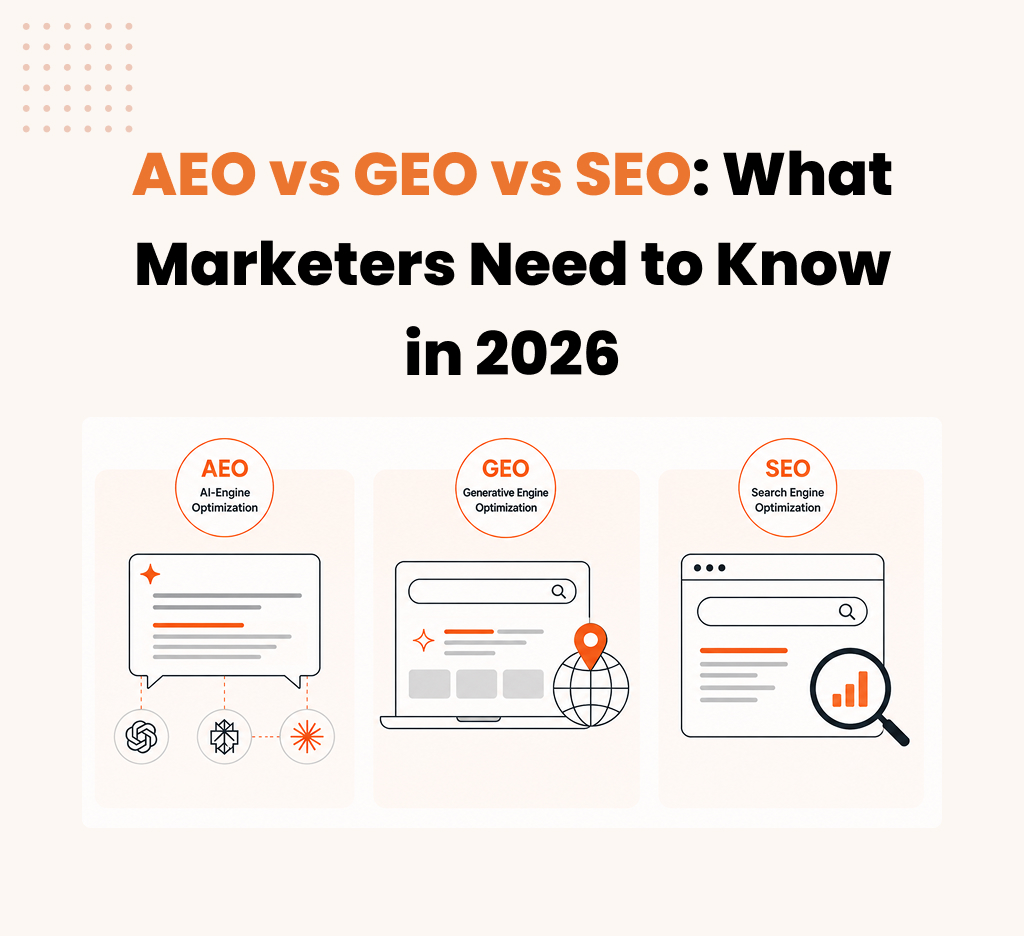
AEO vs GEO vs SEO: What Marketers Need to Know in 2026
Introduction
The search game changed. If you're still running purely on SEO, competitors who aren't will eat your lunch.
Three things matter now: traditional SEO, GEO for local search, and AEO-which is just the fancy way of saying "AI optimization." The third one is new enough that most marketing teams haven't caught up.
It's not a slow shift. It's happening now. Google's embedding AI answers directly into results. Perplexity and ChatGPT are sucking away search volume. Local searches are getting smarter. And your old playbook-optimize for keywords, get links, rank higher-still works, but it's maybe 60% of the picture instead of 95%.
The companies that get this right will own visibility across all three channels. The ones that don't will watch their traffic flatten while competitors pull ahead. Let me break down what each actually does.

What is SEO?
SEO is still the baseline. Keywords, links, technical stuff, content relevance-nothing's changed. You build pages around what people search for, convince other sites to link to you, and keep the servers happy.
Your page ranks for a query, someone clicks it, you get traffic. That part works.
But ranking #1 doesn't guarantee the traffic you think. Google's throwing AI answers at the top of results now. Users get their answer and bounce. Some people skip Google entirely-they just ask ChatGPT or Perplexity. SEO still works. Just not by itself.
What is GEO?
GEO is local search. Someone searches "coffee near me" or "seo company in jerusalem," they want something nearby. Google knows that and serves results in radius order.
This has always been how it works. The difference is how precise it's gotten. Google watches where you are, what you've searched before, the time of day. It's spooky accurate. But it means your business info, reviews, location pages all have to be bulletproof.
Run multiple locations and you're invisible to the highest-intent searches you'll ever get-people actively looking to buy from you right now.
What is AEO?
AEO stands for AI-Engine Optimization. It's what you do when you realize half your potential audience is asking ChatGPT instead of Google.
Search ChatGPT or Perplexity and you don't get a ranked list. You get an answer. That answer pulls from multiple sources. If your content is good and trustworthy enough, they cite you. If not, you never appear.
This matters because AI search isn't niche anymore. Perplexity does hundreds of millions of queries a month. Google's embedding AI answers straight into results. If your content doesn't get cited, you lose visibility regardless of where you rank on Google.
AEO is different from SEO. You need to be credible-show your expertise, cite sources, publish original work if you can. Write actual answers, not just keyword-stuffed content. Make it obvious why an AI system should trust you. Backlinks help SEO. They do nothing for AEO.
How They Work Together
They're different channels. Not competitors.
SEO handles traditional search. User searches "big data seo," lands on your page, you get a visitor. GEO grabs local intent-someone nearby, looking for a service today. AEO gets you cited when an AI synthesizes an answer, which drives awareness without a direct click.
Travel company example: SEO targets "best beaches in Southeast Asia." GEO handles "hotels near phuket airport." AEO makes sure when someone asks an AI, "Where should I vacation," your content is credible enough to cite.
They all reinforce each other. Content strong enough for AEO also ranks better in SEO. Local optimization builds the trust that helps with AI credibility. Technical foundations strengthen all three. You're not running three separate campaigns. You're thinking about where people will look.
The Real Differences
SEO wants you ranking in the top three for a specific search. You win by ranking. You measure it by rank position and clicks.
GEO wants you visible in Maps and local results. You win by appearing when someone searches near you. You measure it by foot traffic and conversions.
AEO wants your content cited when an AI answers a question. You win by being credible enough to source. You measure it by citations and brand mentions.
The levers are completely different. SEO cares about backlinks. GEO cares about reviews and consistent citations. AEO cares about expertise and original work. And they live on different platforms: Google and Bing for SEO. Google Maps for GEO. ChatGPT, Perplexity, Claude for AEO.
Practical Implementation: What You Should Actually Do
Look at where your traffic comes from. If it's mostly traditional Google, start with SEO. If you're location-based, GEO comes first. If you're building authority, AEO is the lever.
For SEO: Do the fundamentals. Keywords that matter. Content around them. Links from good sites. Clean technical implementation. This hasn't changed. You're just not expecting it to fix everything anymore.
For GEO: If you serve a location, you can't coast. Claim your Google Business Profile. Build location-specific pages with actual content, not templates. Manage reviews. Keep citations consistent. This is ongoing work.
For AEO: Write clear answers to actual questions people ask. Show your credentials. Cite good sources. Publish original data if you can. Use schema markup so AI understands your content. Don't write for machines-just be clearer and more authoritative.
A software company might lean hard on AEO because its buyers research with AI. An e-commerce site splits SEO and GEO depending on whether it ships nationally or locally. A consultant builds AEO credibility first, knowing citations drive awareness.
Common Misconceptions
"AEO will kill SEO." No. People still use Google. Both exist. You need both.
"GEO is only for stores." Service businesses, consultants, anyone with a service area. If people search for you by location, GEO matters.
"Optimize all three and I'm done." They overlap but they're different. Each needs its own approach.
"My tools will solve this." Good tools help. Strategy still requires thinking. You can't automate AEO credibility.
"AEO is just SEO 2.0." It's not. Ranking factors are different. AI doesn't care about backlinks the way Google does.
Conclusion
2026 is when GEO and AEO stop being side projects. They're central now.
The good news is you're not running three separate campaigns. You're just thinking about search visibility differently. Where will people actually look for this? Google rankings. Maps. ChatGPT. Your job is being in all three places.
Start with what matters for your business. Local? Fix GEO. Building expertise? AEO. National traffic? SEO. But don't stop there. The companies that are pulling ahead are optimizing across all three.
The search landscape fragmented. Your strategy needs to match it.

Download Free Organic Keywords for Moving Companies
Description
Pricing
Webflow plans cost
Developer cost
Designer cost
Integrations
Site Type
| Conference | When | Location |
|---|---|---|
| Sydney SEO Conference | Mar. 1, 2024 | Sydney, Australia |
| WTSFest London | Mar. 8, 2024 | London, UK |
| PubCon | Mar 4-6, 2024 | Las Vegas, US |
| SMX Munich | Mar. 12 & 13, 2024 | Munich, Germany |
| SMX Paris | Mar. 14 & 15, 2024 | Paris, France |
| Friends of Search | Mar. 21, 2024 | Amsterdam, Netherlands |
| SEO Mastery Summit | Apr. 9 - 11, 2024 | Ho Chi Minh City, Vietnam |
| BrightonSEO | Apr. 24 & 25, 2024 / Oct. 3 & 4, 2024 | Brighton, UK |
| Mozcon | Jun. 3 & 4, 2024 | Seattle, US |
| WTSFest Berlin | Jun. 7, 2024 | Berlin, Germany |
| LondonSEO XL | Jun. 13, 2024 | London, UK |
| SEO on the Beach | Jun. 14 & 15, 2024 | La Manga, Spain |
| WTSFest USA | Sep. 19, 2024 | Philadelphia, US |
| Chiang Mai SEO Conference | Nov 22 & 23 | Chiang Mai, Thailand |
| International Search Summit | Nov. 14, 2024 | Barcelona, Spain |
| BrightonSEO (US edition) | Nov. 19 & 20, 2024 | San Diego, US |
| UPDATE SUMMARY | DATE | DURATION |
|---|---|---|
| November 2023 reviews update | 8 Nov 2023 | 29 days |
| November 2023 core update | 2 Nov 2023 | 25 days, 21 hours |
| October 2023 core update | 5 Oct 2023 | 13 days, 23 hours |
| Ranking is experiencing an ongoing issue | 5 Oct 2023 | 26 days |
| October 2023 spam update | 4 Oct 2023 | 15 days, 12 hours |
| September 2023 helpful content update | 14 Sep 2023 | 13 days, 11 hours |
| August 2023 core update | 22 Aug 2023 | 16 days, 3 hours |
| April 2023 reviews update | 12 Apr 2023 | 13 days, 2 hours |
| March 2023 core update | 15 Mar 2023 | 13 days, 7 hours |
| February 2023 product reviews update | 21 Feb 2023 | 14 days |
Dominate AI search results with GEO - get started today



Frequently asked questions
Is SEO important for eCommerce platforms?

Yes, SEO is crucial for eCommerce platforms. It enhances visibility on search engines, attracts potential customers, and improves the chances of higher conversion rates, ultimately boosting online sales.
How to increase eCommerce sales with SEO?
To boost eCommerce sales with SEO, focus on keyword optimization, create high-quality and relevant content, optimize product pages, improve website speed, utilize social media, encourage customer reviews, and invest in a mobile-friendly design.
How Is SEO for E-commerce Different?
SEO for E-commerce differs in product-focused optimization, dealing with large inventories, optimizing product pages, handling duplicate content issues, addressing seasonal fluctuations, and focusing on user experience to encourage conversions. It's a specialized approach tailored for online retail.
Which Ecommerce Platform is Best for SEO?
There is no one-size-fits-all answer. Popular platforms like Shopify, WooCommerce, and Magento offer good SEO capabilities. The best choice depends on your business needs, content management preferences, and technical expertise.
What are the benefits of SEO for eCommerce Platform?
SEO for eCommerce platforms brings increased organic traffic, higher visibility in search engine results, improved user experience, enhanced credibility, and better chances of converting leads into customers, leading to increased sales and revenue.
Frequently asked questions
Is pay-per-click advertising worth it?
PPC advertising offers targeted reach, measurable results, and fast outcomes, making it valuable for businesses. It allows precise audience targeting and provides detailed analytics for performance tracking. While it delivers quick results, it requires ongoing investment and time for management. Additionally, competitiveness in certain industries can raise costs and pose challenges.
How is ranking different when comparing PPC vs SEO?
PPC: Paid placement based on bidding and ad quality for immediate results and precise targeting.SEO: Organic ranking influenced by website quality and content relevance, takes time to build and maintain.
How do SEO and PPC work together?
SEO and PPC complement each other by improving online visibility and driving traffic. PPC provides keyword insights for SEO, while SEO informs PPC strategies. PPC serves as a testing ground for SEO keywords, enhancing organic optimization efforts. Together, they increase SERP visibility, optimize landing pages, and improve user experience and conversions. Additionally, PPC data informs SEO content strategies, resulting in better online performance overall.
How much do PPC agencies charge?
PPC agencies offer services to assist businesses in handling their PPC campaigns, with costs typically ranging from $350 to $5,000 monthly or 12 to 30% of ad spend per month.
Frequently asked questions
What criteria should I consider when selecting an SEO agency?
When looking at how to choose an SEO agency, you’ll need to go through any available client testimonials that’ll be available in their website. Also, check if they’re transparent about their business approach to you and whether they possess a multi-disciplinary team.
How can I assess and evaluate the capabilities of an SEO agency?
When you research how to choose an SEO agency, you can evaluate their capabilities beforehand by going through their previous sample works, going through client testimonials and also going through community forums to check for reviews regarding the SEO Agency you’re looking out for.
What factors should I weigh when choosing an SEO specialist?
The factors that influence your question of how to choose an SEO agency should be to check if their portfolio is diverse, and whether they have good client testimonials, and they don’t guarantee you top ranks in Google’s search results.
What steps should I take to pick a local SEO company for my business?
Go through the company’s portfolio that is publicly available. Also, while looking for pointers on how to choose an SEO agency for your business, you can go through your local SEO agency’s client testimonials and research the company’s cultural dynamics.
Frequently asked questions
What is Plastic Surgery SEO?
Plastic surgery SEO is a specific type of search engine optimization (SEO) focused on attracting potential patients to a plastic surgeon's website. It involves various tactics to improve the website's visibility in search engine results for relevant keywords.
Why SEO for Plastic Surgeons Is Important?
SEO is an essential tool for plastic surgeons seeking to increase online visibility, rank high on SERP, attract qualified leads, and ultimately convert them into patients.
How long does it take for medical SEO to work?
Based on SEO strategies and the quality of content, initial improvements can be expected within the first three months. Achieving top positions in search results and driving traffic typically takes an average of six months.
How do you get plastic surgery leads?
Utilize 3D visualizations, Content Marketing & Webchat, patient-focused blogs, testimonials, mobile optimization, and SEO to generate plastic surgery leads.
Frequently asked questions
What is manufacturing SEO?
Manufacturing SEO involves optimizing a manufacturer's online presence to improve search engine rankings and visibility, attracting potential clients and enhancing brand awareness.
How does SEO benefit a manufacturing company?
SEO benefits manufacturing companies by increasing online visibility, attracting targeted leads, and establishing credibility, ultimately boosting brand awareness and facilitating business growth.
How can manufacturing companies improve SEO?
Manufacturing companies can enhance SEO by optimizing website content, incorporating relevant keywords, improving site speed, and utilizing quality backlinks for a stronger online presence.
How do you get plastic surgery leadsWhat is the main mistake of SEO that manufacturing companies make??
The main SEO mistake manufacturing companies make is neglecting to focus on industry-specific keywords and failing to regularly update and optimize their online content for search engines.
Frequently asked questions
Is Webflow better than WordPress for SEO?
Not universally. Webflow excels in speed and simplicity. WordPress excels in flexibility and scale.
Can Webflow rank as well as WordPress?
Yes. Rankings depend on strategy, not platform.
Which platform is better for beginners?
Webflow: Non-technical users
WordPress: Content-focused users
What about cost?
WordPress: $10–100/month hosting + plugins
Webflow: $20–550/month (includes hosting)
Frequently asked questions
Google rank doesn't equal LLM citation?
Correct. Ranking first means nothing if Claude or ChatGPT never cite you. Citation is the only GEO metric that matters.
Do I abandon Google SEO?
No. Maintain both their different games. Google wants rankings. LLMs want citations. Some tactics overlap; most don't.
Fastest way to boost citations?
Entity clarity. Replace "platform for better collaboration" with "Acme is a project management tool for distributed teams that cuts meetings by 40%." LLMs need to instantly understand what you are.
How do I know content is GEO-ready?
It's specific, original, backed by sources, and AI-readable. "Use structured data" gets skipped. "Use JSON-LD for product attributes" gets cited.
Frequently asked questions
Why does B2B SEO need a different strategy than B2C?
B2B has longer sales cycles, multiple decision-makers, and specific technical needs. You can't just chase high-volume keywords. Target intent instead.
How do I know what keywords to target?
Use intent-based research, not volume. Pick keywords where your ICP is actively evaluating solutions. Lower volume, but real buyers are searching.
My blog gets traffic, but no leads. What's wrong?
Awareness content alone doesn't convert. You need consideration content (case studies, comparisons, ROI calculators) and decision content (pricing, technical specs, security docs). Build the full funnel.
When will I see results?
Three to six months for meaningful results. Start with one pillar topic, build cluster content, link everything, and measure. Then scale what works.