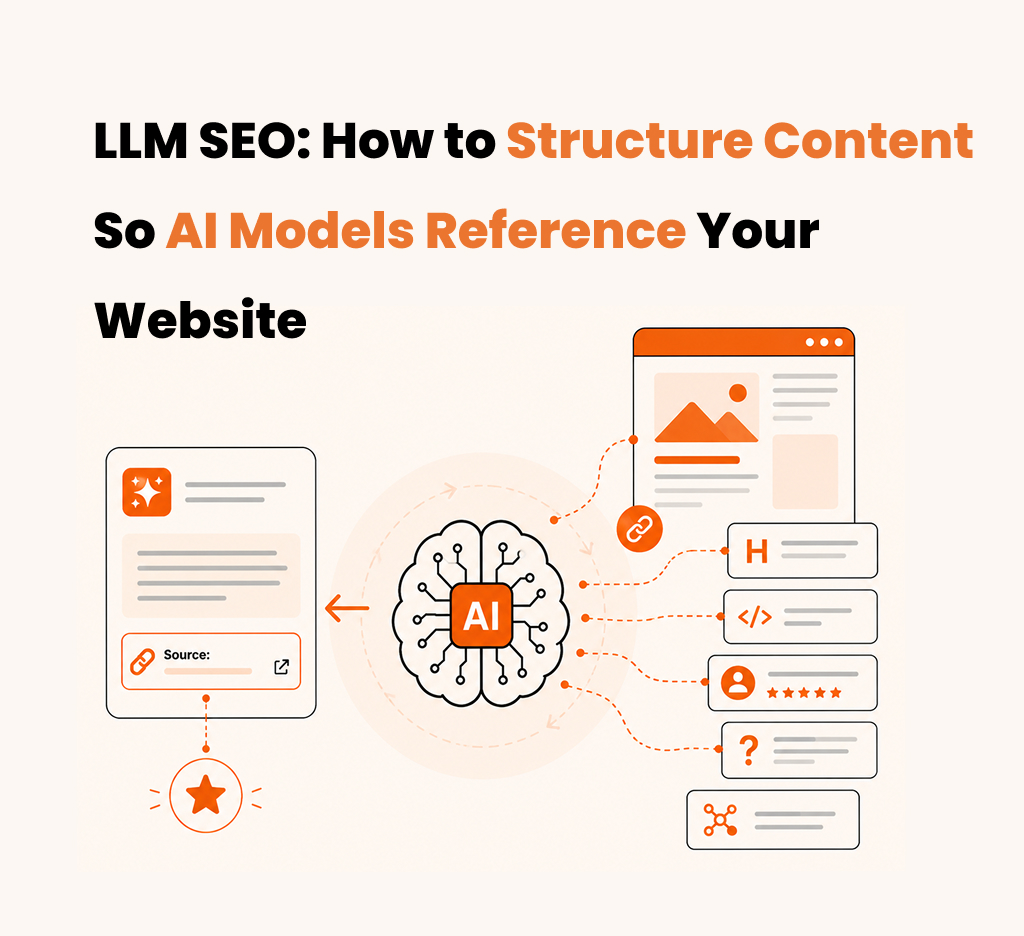
LLM SEO: How to Structure Content So AI Models Reference Your Website
LLM SEO: How to Structure Your Content So AI Models Cite You as a Source
Introduction
The search landscape is shifting beneath our feet. For decades, SEO meant optimizing for Google's algorithm-crafting meta descriptions, building backlinks, and chasing keyword rankings. But today, a new gatekeeper is emerging: Large Language Models. When millions of people ask ChatGPT, Claude, or Perplexity a question instead of typing into Google, they're no longer just looking for blue links-they're looking for cited sources. And if your website isn't visible to these AI models, you're invisible to an entire category of modern searchers.
This isn't traditional SEO optimized for a bot. This is LLM SEO-optimizing your content so artificial intelligence systems recognize, understand, and cite your website as an authoritative source. It's a fundamentally different challenge, and it's reshaping how content creators should think about visibility and authority.
What is LLM SEO?
LLM SEO is the practice of structuring and formatting your content in ways that make it more likely for large language models to understand, reference, and attribute your work in their responses. Unlike traditional SEO, which optimizes for search engine crawlers, LLM SEO optimizes for AI comprehension and citation behavior.
These models are trained on enormous amounts of internet content, but they don't simply retrieve and regurgitate. They synthesize information, generate original responses, and when appropriate, cite the sources that informed their answer. The question is: will your content be among those cited sources, or will you remain invisible despite being relevant?
How AI Models Reference Content
Understanding how LLMs decide to cite sources is crucial to optimizing for them. When an AI model generates a response, it doesn't search the web in real-time (though some platforms like Perplexity do). Instead, it draws on its training data-a snapshot of the internet taken at a specific point in time. The model then decides which sources to attribute based on several factors.
First, clarity matters. If your content is ambiguous, poorly structured, or buried in walls of text, the model may understand it but struggle to properly attribute it. Second, authority signals matter. Content that clearly establishes expertise through author credentials, comprehensive coverage, or expert consensus is more likely to be cited. Third, semantic clarity matters. If your content uses clear language and logical structure, the model can more easily parse exactly what you're claiming, making it easier to cite accurately. Finally, structured data matters. When you use schema markup to explicitly define your content type, author, publication date, and topic, you're giving AI models a language they understand natively.
Why Most Websites Are Invisible to AI Models
Most websites face a silent crisis with LLM SEO. Your content might be excellent. It might rank well on Google. But if it's not structured in ways that AI models can easily understand and attribute, it becomes invisible to a growing segment of search traffic.
This invisibility manifests in several ways. First, your content may be used to inform AI responses without any attribution whatsoever. An AI might synthesize your insights into its answer while citing three other sources instead. Second, even when cited, unclear or poorly structured content may be misattributed or misrepresented. Third, you're losing traffic to platforms like ChatGPT and Perplexity that are actively drawing users away from traditional search. Finally, you're missing the opportunity to build authority in an emerging search paradigm where direct attribution from AI models becomes a critical credibility signal.
How to Make Your Content LLM-Ready
The good news is that LLM SEO is not rocket science-it's a combination of sound content strategy, technical implementation, and clarity of communication. The fundamental principle is this: structure your content in ways that make it unmistakably valuable, clearly authoritative, and semantically transparent to artificial intelligence systems.
This doesn't mean changing your entire content strategy. It means adding layers of clarity and structure that serve both human readers and machine understanding. When you optimize for LLMs, you're typically improving your content for humans as well.
5 Steps to Structure Your Content for AI Model Citations
Step 1: Use Clear Topic Clustering and Semantic Coherence
Begin by organizing your content around tightly defined topics and themes. Rather than creating one sprawling article about "digital marketing," create focused content pieces about specific subtopics: email marketing ROI, conversion rate optimization, customer retention strategies. This clarity helps LLMs understand exactly what your content is about and when it's relevant to cite.
Within each article, use clear hierarchical headings that signal your content structure. H1 for the main topic, H2 for major subtopics, H3 for supporting ideas. This isn't just for readability-it's a machine-readable map of your content's semantic structure. AI models use heading hierarchies to understand the logical flow and importance of different sections.
Step 2: Implement Structured Data and Schema Markup
This is where technical implementation becomes essential. Use Schema.org markup to explicitly define your content's metadata. Mark up your author using the creator or author schema, include the publication date with datePublished, define the article type, and specify your topic using keywords and article body schemas. This additional layer of machine-readable metadata gives AI models explicit information about who wrote this content, when, and what it covers.
You don't need to be a developer to implement basic schema markup. Platforms like Google's Structured Data Markup Helper can guide you through the process, and many content management systems have schema plugins that automate much of the work. Even basic schema implementation significantly improves how AI models parse and attribute your content.
Step 3: Optimize for Query Intent Clarity
Different types of content serve different intents. Some content is definitional-it explains what something is. Some is procedural-it explains how to do something. Some is comparative-it weighs options against each other. AI models recognize these different content types and cite them appropriately based on the query intent.
Make your intent crystal clear. If you're writing a definition, structure it as a proper definition. If you're writing a how-to guide, structure it as clear steps. If you're providing analysis or research, make that explicit. When your content's purpose is unmistakable, AI models can confidently cite it when appropriate.
Step 4: Build Content Authority Signals
AI models use multiple signals to assess content authority. Author expertise is one-make your author credentials visible. Original research is another-if you've conducted surveys, experiments, or data analysis, make that clear and cite your methodology. Expert consensus is another signal-if your content aligns with widely accepted expert opinion, that's worth noting. Comprehensiveness matters too; content that thoroughly covers its topic is viewed as more authoritative than shallow treatments.
Think about what makes your content uniquely valuable. Is it original research? Expert analysis? Comprehensive synthesis of existing knowledge? Practical case studies? Whatever it is, make it obvious. AI models are looking for signals that distinguish authoritative content from thin, derivative content.
Step 5: Monitor and Test AI Citations
Unlike traditional SEO, where you can check rankings and traffic, LLM citations are harder to track. But you can still monitor them. Periodically search for your content topics on ChatGPT, Claude, Perplexity, and other AI platforms. See if and how your content is cited. Identify gaps where relevant content isn't being cited. Use these insights to refine your content structure and optimization approach.
Some AI platforms are developing tools for creators to claim and verify their content. Stay informed about these emerging opportunities and claim your content where possible.
What LLM SEO Optimization Actually Delivers
When you optimize your content for LLM visibility and citation, several things happen. First, you gain visibility in an entirely new search paradigm where AI-powered answers are increasingly how people find information. Second, you build credibility through direct attribution from trusted AI systems-a citation from ChatGPT carries weight. Third, you create opportunities for traffic from AI platforms, which are rapidly becoming competitive with traditional search. Finally, you future-proof your content strategy for a world where AI-driven information access is becoming dominant rather than niche.
Common LLM SEO Mistakes to Avoid
As you implement LLM SEO, watch for common mistakes. Avoid keyword stuffing; even for AI, clarity trumps optimization every time. Don't implement schema markup incorrectly or deceptively, as this can actually harm your credibility. Don't sacrifice human readability for machine optimization; the best content works well for both. And don't ignore traditional SEO in pursuit of LLM optimization-the two are complementary, not competitive.
Also, be aware that LLM training data has cutoff dates. Content you publish today may not be included in the next training cycle for months or years. This doesn't mean you shouldn't optimize-it means combining LLM SEO with active distribution and visibility building.
Conclusion
The search landscape is evolving, and LLM SEO represents the next frontier of content visibility. It's not about gaming algorithms or cutting corners-it's about making your content unmistakably valuable and crystal clear to both human readers and artificial intelligence systems. By structuring your content with clarity, authority, and semantic coherence, you're not just optimizing for tomorrow's search. You're ensuring your work gets recognized, cited, and trusted in an AI-driven information landscape.
The time to start isn't when AI search becomes mainstream. It's now, when you still have the opportunity to establish authority and visibility in an emerging paradigm. Start with your most important topics, implement clear structure and schema markup, monitor how AI systems cite your work, and iterate. The future of content visibility isn't guesswork-it's strategic preparation.
FAQ
Will LLM SEO replace traditional SEO?
No. Traditional search engines remain dominant for now, and LLM-based search is still emerging. The winning strategy is optimizing for both simultaneously, which typically means better content and clearer structure, benefits that serve all users.
How long does it take to see results from LLM SEO?
LLM citations may take longer to appear than traditional search rankings because they depend on model training cycles. But once your content is included in a model's training data and properly structured, citations can begin accumulating quickly.
Is LLM SEO more important than traditional SEO?
Not yet, but it's becoming increasingly important. Smart content creators are preparing now rather than reacting later when AI-driven search becomes dominant in their industry.

Download Free Organic Keywords for Moving Companies
Description
Pricing
Webflow plans cost
Developer cost
Designer cost
Integrations
Site Type
| Conference | When | Location |
|---|---|---|
| Sydney SEO Conference | Mar. 1, 2024 | Sydney, Australia |
| WTSFest London | Mar. 8, 2024 | London, UK |
| PubCon | Mar 4-6, 2024 | Las Vegas, US |
| SMX Munich | Mar. 12 & 13, 2024 | Munich, Germany |
| SMX Paris | Mar. 14 & 15, 2024 | Paris, France |
| Friends of Search | Mar. 21, 2024 | Amsterdam, Netherlands |
| SEO Mastery Summit | Apr. 9 - 11, 2024 | Ho Chi Minh City, Vietnam |
| BrightonSEO | Apr. 24 & 25, 2024 / Oct. 3 & 4, 2024 | Brighton, UK |
| Mozcon | Jun. 3 & 4, 2024 | Seattle, US |
| WTSFest Berlin | Jun. 7, 2024 | Berlin, Germany |
| LondonSEO XL | Jun. 13, 2024 | London, UK |
| SEO on the Beach | Jun. 14 & 15, 2024 | La Manga, Spain |
| WTSFest USA | Sep. 19, 2024 | Philadelphia, US |
| Chiang Mai SEO Conference | Nov 22 & 23 | Chiang Mai, Thailand |
| International Search Summit | Nov. 14, 2024 | Barcelona, Spain |
| BrightonSEO (US edition) | Nov. 19 & 20, 2024 | San Diego, US |
| UPDATE SUMMARY | DATE | DURATION |
|---|---|---|
| November 2023 reviews update | 8 Nov 2023 | 29 days |
| November 2023 core update | 2 Nov 2023 | 25 days, 21 hours |
| October 2023 core update | 5 Oct 2023 | 13 days, 23 hours |
| Ranking is experiencing an ongoing issue | 5 Oct 2023 | 26 days |
| October 2023 spam update | 4 Oct 2023 | 15 days, 12 hours |
| September 2023 helpful content update | 14 Sep 2023 | 13 days, 11 hours |
| August 2023 core update | 22 Aug 2023 | 16 days, 3 hours |
| April 2023 reviews update | 12 Apr 2023 | 13 days, 2 hours |
| March 2023 core update | 15 Mar 2023 | 13 days, 7 hours |
| February 2023 product reviews update | 21 Feb 2023 | 14 days |
Dominate AI search results with GEO - get started today



Frequently asked questions
Is SEO important for eCommerce platforms?

Yes, SEO is crucial for eCommerce platforms. It enhances visibility on search engines, attracts potential customers, and improves the chances of higher conversion rates, ultimately boosting online sales.
How to increase eCommerce sales with SEO?
To boost eCommerce sales with SEO, focus on keyword optimization, create high-quality and relevant content, optimize product pages, improve website speed, utilize social media, encourage customer reviews, and invest in a mobile-friendly design.
How Is SEO for E-commerce Different?
SEO for E-commerce differs in product-focused optimization, dealing with large inventories, optimizing product pages, handling duplicate content issues, addressing seasonal fluctuations, and focusing on user experience to encourage conversions. It's a specialized approach tailored for online retail.
Which Ecommerce Platform is Best for SEO?
There is no one-size-fits-all answer. Popular platforms like Shopify, WooCommerce, and Magento offer good SEO capabilities. The best choice depends on your business needs, content management preferences, and technical expertise.
What are the benefits of SEO for eCommerce Platform?
SEO for eCommerce platforms brings increased organic traffic, higher visibility in search engine results, improved user experience, enhanced credibility, and better chances of converting leads into customers, leading to increased sales and revenue.
Frequently asked questions
Is pay-per-click advertising worth it?
PPC advertising offers targeted reach, measurable results, and fast outcomes, making it valuable for businesses. It allows precise audience targeting and provides detailed analytics for performance tracking. While it delivers quick results, it requires ongoing investment and time for management. Additionally, competitiveness in certain industries can raise costs and pose challenges.
How is ranking different when comparing PPC vs SEO?
PPC: Paid placement based on bidding and ad quality for immediate results and precise targeting.SEO: Organic ranking influenced by website quality and content relevance, takes time to build and maintain.
How do SEO and PPC work together?
SEO and PPC complement each other by improving online visibility and driving traffic. PPC provides keyword insights for SEO, while SEO informs PPC strategies. PPC serves as a testing ground for SEO keywords, enhancing organic optimization efforts. Together, they increase SERP visibility, optimize landing pages, and improve user experience and conversions. Additionally, PPC data informs SEO content strategies, resulting in better online performance overall.
How much do PPC agencies charge?
PPC agencies offer services to assist businesses in handling their PPC campaigns, with costs typically ranging from $350 to $5,000 monthly or 12 to 30% of ad spend per month.
Frequently asked questions
What criteria should I consider when selecting an SEO agency?
When looking at how to choose an SEO agency, you’ll need to go through any available client testimonials that’ll be available in their website. Also, check if they’re transparent about their business approach to you and whether they possess a multi-disciplinary team.
How can I assess and evaluate the capabilities of an SEO agency?
When you research how to choose an SEO agency, you can evaluate their capabilities beforehand by going through their previous sample works, going through client testimonials and also going through community forums to check for reviews regarding the SEO Agency you’re looking out for.
What factors should I weigh when choosing an SEO specialist?
The factors that influence your question of how to choose an SEO agency should be to check if their portfolio is diverse, and whether they have good client testimonials, and they don’t guarantee you top ranks in Google’s search results.
What steps should I take to pick a local SEO company for my business?
Go through the company’s portfolio that is publicly available. Also, while looking for pointers on how to choose an SEO agency for your business, you can go through your local SEO agency’s client testimonials and research the company’s cultural dynamics.
Frequently asked questions
What is Plastic Surgery SEO?
Plastic surgery SEO is a specific type of search engine optimization (SEO) focused on attracting potential patients to a plastic surgeon's website. It involves various tactics to improve the website's visibility in search engine results for relevant keywords.
Why SEO for Plastic Surgeons Is Important?
SEO is an essential tool for plastic surgeons seeking to increase online visibility, rank high on SERP, attract qualified leads, and ultimately convert them into patients.
How long does it take for medical SEO to work?
Based on SEO strategies and the quality of content, initial improvements can be expected within the first three months. Achieving top positions in search results and driving traffic typically takes an average of six months.
How do you get plastic surgery leads?
Utilize 3D visualizations, Content Marketing & Webchat, patient-focused blogs, testimonials, mobile optimization, and SEO to generate plastic surgery leads.
Frequently asked questions
What is manufacturing SEO?
Manufacturing SEO involves optimizing a manufacturer's online presence to improve search engine rankings and visibility, attracting potential clients and enhancing brand awareness.
How does SEO benefit a manufacturing company?
SEO benefits manufacturing companies by increasing online visibility, attracting targeted leads, and establishing credibility, ultimately boosting brand awareness and facilitating business growth.
How can manufacturing companies improve SEO?
Manufacturing companies can enhance SEO by optimizing website content, incorporating relevant keywords, improving site speed, and utilizing quality backlinks for a stronger online presence.
How do you get plastic surgery leadsWhat is the main mistake of SEO that manufacturing companies make??
The main SEO mistake manufacturing companies make is neglecting to focus on industry-specific keywords and failing to regularly update and optimize their online content for search engines.
Frequently asked questions
Is Webflow better than WordPress for SEO?
Not universally. Webflow excels in speed and simplicity. WordPress excels in flexibility and scale.
Can Webflow rank as well as WordPress?
Yes. Rankings depend on strategy, not platform.
Which platform is better for beginners?
Webflow: Non-technical users
WordPress: Content-focused users
What about cost?
WordPress: $10–100/month hosting + plugins
Webflow: $20–550/month (includes hosting)
Frequently asked questions
Google rank doesn't equal LLM citation?
Correct. Ranking first means nothing if Claude or ChatGPT never cite you. Citation is the only GEO metric that matters.
Do I abandon Google SEO?
No. Maintain both their different games. Google wants rankings. LLMs want citations. Some tactics overlap; most don't.
Fastest way to boost citations?
Entity clarity. Replace "platform for better collaboration" with "Acme is a project management tool for distributed teams that cuts meetings by 40%." LLMs need to instantly understand what you are.
How do I know content is GEO-ready?
It's specific, original, backed by sources, and AI-readable. "Use structured data" gets skipped. "Use JSON-LD for product attributes" gets cited.
Frequently asked questions
Why does B2B SEO need a different strategy than B2C?
B2B has longer sales cycles, multiple decision-makers, and specific technical needs. You can't just chase high-volume keywords. Target intent instead.
How do I know what keywords to target?
Use intent-based research, not volume. Pick keywords where your ICP is actively evaluating solutions. Lower volume, but real buyers are searching.
My blog gets traffic, but no leads. What's wrong?
Awareness content alone doesn't convert. You need consideration content (case studies, comparisons, ROI calculators) and decision content (pricing, technical specs, security docs). Build the full funnel.
When will I see results?
Three to six months for meaningful results. Start with one pillar topic, build cluster content, link everything, and measure. Then scale what works.