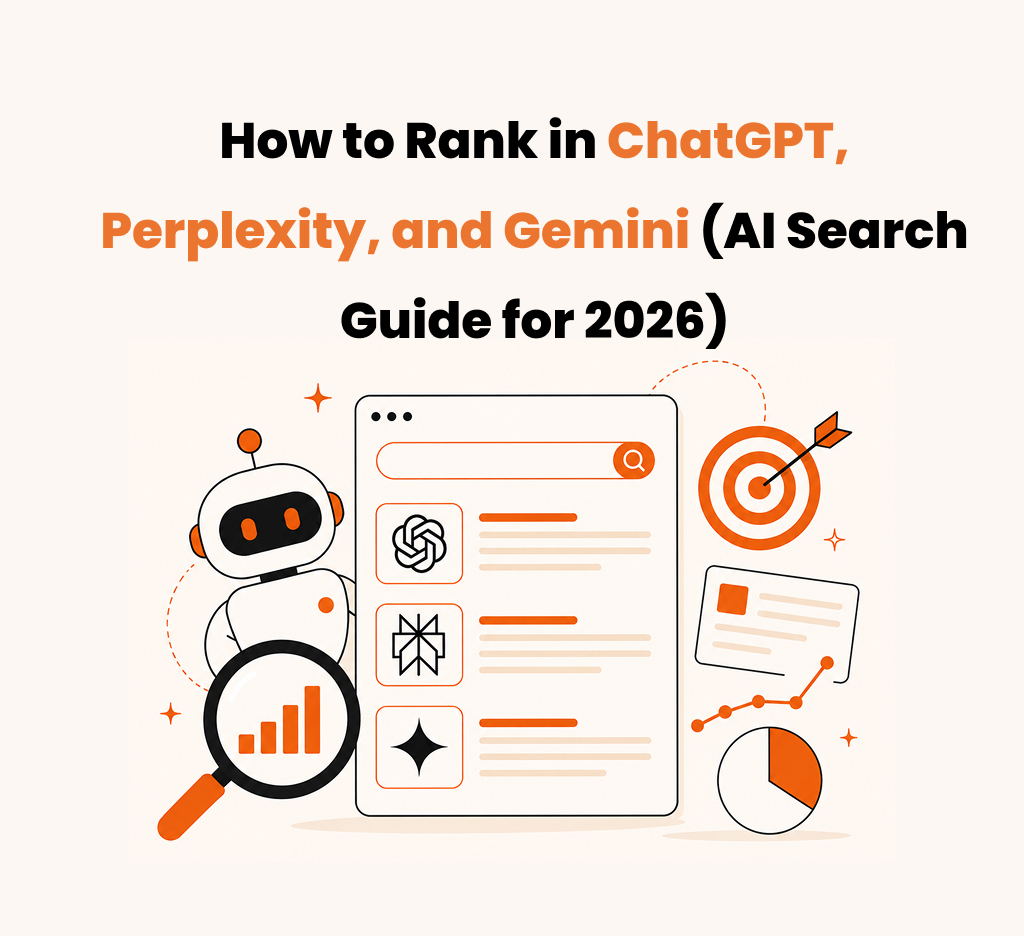
How to Rank in ChatGPT, Perplexity, and Gemini (AI Search Guide for 2026)
How to Rank in ChatGPT, Perplexity, and Gemini: The AI Search Guide for 2026
Two content creators published on the same topic last month. Both did solid research. Both wrote well. But one appears in ChatGPT's answers. The other doesn't. One gets cited by Perplexity constantly. The other is invisible. Google ranks them equally. But AI search? One won, one lost. The difference isn't better writing. It's understanding how AI systems choose their sources, and most creators don't.
This guide walks you through the unique ranking factors of each major AI search engine and gives you actionable strategies to get your content in front of millions of AI-powered searchers in 2026.
What is AI Search Ranking?
AI search ranking is the process by which ChatGPT, Perplexity, Gemini, and similar platforms evaluate, select, and cite your website as a source when answering user queries. Unlike Google's algorithm, which ranks pages for keywords, AI search engines source answers from multiple websites simultaneously-and often cite them directly in their responses. Your goal isn't just to rank; it's to become a trusted source that AI systems cite repeatedly.
How AI Search Engines Work Differently from Google
Traditional SEO optimizes for keywords. AI search optimizes for answers. When someone asks Perplexity, "How do I clean up AI-generated code?", the system doesn't just find a keyword match-it evaluates dozens of sources, determines which ones have the most accurate, comprehensive answer, and cites the best ones. The ranking factors are fundamentally different.
The shift from manual to autonomous discovery is also reshaping the landscape. As detailed in our guide on agentic AI browsers and the shift from manual to autonomous web, AI systems no longer just crawl static pages-they actively browse, test, and evaluate content in real-time. This means freshness, accuracy, and demonstration of expertise matter more than ever.
Here's what these platforms prioritize: recency and factual accuracy (ChatGPT), citation frequency and clarity (Perplexity), and intent matching across multiple formats (Gemini). Each has its own signal hierarchy, and the winners understand the difference.
How to Rank in ChatGPT Search: Key Factors and Optimization Tips
ChatGPT's search feature draws from OpenAI's index of public web content, prioritizing sources that are fresh, authoritative, and well-aligned with user intent. If you want visibility in ChatGPT search results and citations, focus on these factors.
Why Freshness and Recency Dominate ChatGPT Rankings dominate ChatGPT's ranking. The platform favors recently updated content, particularly on fast-moving topics like AI, technology, and current events. If your article is six months old on a topic that's evolving weekly, you're at a disadvantage. Update your cornerstone content regularly, add dates to posts, and ensure your publish/update timestamps are accurate in your metadata.
Domain Authority and E-A-T matter significantly. ChatGPT weighs sources from established domains with demonstrated expertise. If you're writing about AI, your author bios should clearly state relevant credentials. Your site should have clear contact information, an about page, and a consistent topical focus. This isn't just for SEO-it's a trust signal for the AI.
Why Content Depth and Accuracy Are Non-Negotiable for ChatGPT are non-negotiable. ChatGPT systems fact-check before citing. If your article has inaccuracies or is thin on detail, it won't get cited, no matter how popular it is. Write comprehensive, well-researched pieces that demonstrate you've genuinely investigated the topic.
To optimize: publish frequently on your core topic, maintain a clear author bio with credentials, keep metadata (date, author, title) accurate and visible, and ensure your content is factually bulletproof.
Perplexity Search: Citation Frequency as the Core Signal
Perplexity's entire model is built on citations. Every answer includes multiple sources, and the sources that appear most often in Perplexity responses earn the most visibility. If you want to rank in Perplexity, you need to understand what makes a source cite-worthy.
Citation frequency is the primary ranking signal. Perplexity uses a sophisticated evaluation system to determine which sources best answer a user's specific question. A source that has been cited ten times for similar queries is more likely to be selected again. This creates a compounding effect: early visibility builds more visibility over time.
This connects directly to how AI search engines choose sources. In our deep dive into how AI search engines choose which websites to cite, we explore the criteria that Perplexity and similar platforms use to evaluate trustworthiness, answer quality, and source reputation. Understanding these signals is essential for long-term ranking.
Content Structure and Clarity determine whether Perplexity can extract your answer efficiently. Use clear headings, concise paragraphs, and structured data where possible. If your article answers the question in the first three paragraphs, Perplexity can pull that snippet more easily than if the answer is buried on page five.
Topical Authority signals expertise across a topic cluster. If you write about AI tools, write about multiple AI tools, not just one. Build interconnected, thematic content that demonstrates you're an authority in the space, not a one-article blogger.
To optimize: write answer-first content that directly responds to user questions, structure your content for easy extraction, build topical clusters around your core expertise, and monitor which of your articles get cited by Perplexity (use their citation links).
How to Rank in Gemini: Intent Matching and Multi-Format Content
Gemini, Google's AI search integration, has an advantage: it's built into Google's ecosystem. It understands search intent deeply and can source from video, images, and interactive content, not just text.
Query Intent Alignment is paramount. Gemini doesn't just match keywords; it understands why someone is asking the question. A user searching "best AI code tools" has a different intent than someone searching "how does AI code generation work". The first wants a comparison; the second wants education. Optimize your headlines, introductions, and metadata to clearly signal which intent you're addressing.
Multi-Format Content Advantage gives you an edge. If you have high-quality video explanations, interactive demos, infographics, or case studies alongside your written content, Gemini's system can surface them. A video walkthrough of your product will rank higher in Gemini than the same information as text alone.
User Satisfaction Signals matter. Gemini tracks bounce rates, time on page, and click-through rates. If users click on your link from Gemini and immediately leave, the system learns your content didn't satisfy their query. High-quality, user-friendly content design is non-negotiable.
To optimize: align your content structure with search intent, create video and visual accompaniments to text, ensure fast page load times and mobile responsiveness, and monitor Gemini's feedback signals through Google Search Console.
Critical Things to Focus on and Fix
Most content creators make the same mistakes when optimizing for AI search. Fix these first:
Outdated Cornerstone Content. If your best-performing article is six months old, update it today. Add new insights, refresh statistics, and update the publish date. AI systems notice and reward fresh takes on evergreen topics.
Hidden or Incorrect Metadata. Many websites bury their author names, publication dates, and last-update information in hard-to-parse formats. Make this information front and center in your HTML metadata and visible on the page.
Thin or Inaccurate Information. AI search engines fact-check before citing. A 300-word article with no sources won't earn citations. Write longer, more authoritative pieces that demonstrate research and expertise.
Inconsistent Topical Focus. If you write about AI one week and cryptocurrency the next, you're diluting your topical authority. Build deep expertise in a specific domain.
No Multi-Format Content. Text-only content is disadvantaged. Add videos, case studies, screenshots, or interactive tools. This matters more in Gemini but is increasingly important across all platforms.
Conclusion: Your AI Search Roadmap for 2026
AI search ranking isn't a replacement for traditional SEO-it's an evolution of it. The winners in 2026 will be the ones who shift their thinking from "ranking for keywords" to "becoming a cited authority". This means writing faster, deeper, and more accurate content. It means maintaining topical focus and building expertise clusters. It means making sure your credentials are visible and your metadata is clean.
Start by auditing your top ten articles across ChatGPT, Perplexity, and Gemini search. Which ones get cited? Which ones don't? Use those signals to guide your content strategy going forward. Update your cornerstone pieces. Build multi-format content. Double down on expertise and accuracy.
The AI search opportunity is massive, and the competition is still relatively light. Move now, and you'll establish authority that pays dividends for years.
FAQ: Common Questions About AI Search Ranking
Q: Do traditional SEO practices still matter?A: Yes, with caveats. Keyword optimization, site speed, and mobile-friendliness still matter because they affect user experience. But keyword density and keyword matching are much less important than they used to be. Focus on answering questions comprehensively instead.
Q: How long does it take to see results?A: AI search engines index faster than Google, but building authority takes time. Early citations may appear within weeks, but consistent visibility builds over months. Monitor your citations and refine based on which articles get cited most.
Q: Should I optimize for one AI search engine or all three?A: The fundamentals (accuracy, freshness, expertise) apply to all. But if your audience heavily uses Perplexity, double down on citation-worthy answers. If they use Google/Gemini, prioritize intent matching. Know your audience first.
Q: What's the difference between ranking in AI search and ranking in Google?A: Google ranks individual pages for keywords. AI search engines cite sources based on answer quality and trustworthiness. You can rank first in Google but never get cited in Perplexity, or vice versa. They're distinct ranking systems that require different strategies.

Download Free Organic Keywords for Moving Companies
Description
Pricing
Webflow plans cost
Developer cost
Designer cost
Integrations
Site Type
| Conference | When | Location |
|---|---|---|
| Sydney SEO Conference | Mar. 1, 2024 | Sydney, Australia |
| WTSFest London | Mar. 8, 2024 | London, UK |
| PubCon | Mar 4-6, 2024 | Las Vegas, US |
| SMX Munich | Mar. 12 & 13, 2024 | Munich, Germany |
| SMX Paris | Mar. 14 & 15, 2024 | Paris, France |
| Friends of Search | Mar. 21, 2024 | Amsterdam, Netherlands |
| SEO Mastery Summit | Apr. 9 - 11, 2024 | Ho Chi Minh City, Vietnam |
| BrightonSEO | Apr. 24 & 25, 2024 / Oct. 3 & 4, 2024 | Brighton, UK |
| Mozcon | Jun. 3 & 4, 2024 | Seattle, US |
| WTSFest Berlin | Jun. 7, 2024 | Berlin, Germany |
| LondonSEO XL | Jun. 13, 2024 | London, UK |
| SEO on the Beach | Jun. 14 & 15, 2024 | La Manga, Spain |
| WTSFest USA | Sep. 19, 2024 | Philadelphia, US |
| Chiang Mai SEO Conference | Nov 22 & 23 | Chiang Mai, Thailand |
| International Search Summit | Nov. 14, 2024 | Barcelona, Spain |
| BrightonSEO (US edition) | Nov. 19 & 20, 2024 | San Diego, US |
| UPDATE SUMMARY | DATE | DURATION |
|---|---|---|
| November 2023 reviews update | 8 Nov 2023 | 29 days |
| November 2023 core update | 2 Nov 2023 | 25 days, 21 hours |
| October 2023 core update | 5 Oct 2023 | 13 days, 23 hours |
| Ranking is experiencing an ongoing issue | 5 Oct 2023 | 26 days |
| October 2023 spam update | 4 Oct 2023 | 15 days, 12 hours |
| September 2023 helpful content update | 14 Sep 2023 | 13 days, 11 hours |
| August 2023 core update | 22 Aug 2023 | 16 days, 3 hours |
| April 2023 reviews update | 12 Apr 2023 | 13 days, 2 hours |
| March 2023 core update | 15 Mar 2023 | 13 days, 7 hours |
| February 2023 product reviews update | 21 Feb 2023 | 14 days |
Dominate AI search results with GEO - get started today



Frequently asked questions
Is SEO important for eCommerce platforms?

Yes, SEO is crucial for eCommerce platforms. It enhances visibility on search engines, attracts potential customers, and improves the chances of higher conversion rates, ultimately boosting online sales.
How to increase eCommerce sales with SEO?
To boost eCommerce sales with SEO, focus on keyword optimization, create high-quality and relevant content, optimize product pages, improve website speed, utilize social media, encourage customer reviews, and invest in a mobile-friendly design.
How Is SEO for E-commerce Different?
SEO for E-commerce differs in product-focused optimization, dealing with large inventories, optimizing product pages, handling duplicate content issues, addressing seasonal fluctuations, and focusing on user experience to encourage conversions. It's a specialized approach tailored for online retail.
Which Ecommerce Platform is Best for SEO?
There is no one-size-fits-all answer. Popular platforms like Shopify, WooCommerce, and Magento offer good SEO capabilities. The best choice depends on your business needs, content management preferences, and technical expertise.
What are the benefits of SEO for eCommerce Platform?
SEO for eCommerce platforms brings increased organic traffic, higher visibility in search engine results, improved user experience, enhanced credibility, and better chances of converting leads into customers, leading to increased sales and revenue.
Frequently asked questions
Is pay-per-click advertising worth it?
PPC advertising offers targeted reach, measurable results, and fast outcomes, making it valuable for businesses. It allows precise audience targeting and provides detailed analytics for performance tracking. While it delivers quick results, it requires ongoing investment and time for management. Additionally, competitiveness in certain industries can raise costs and pose challenges.
How is ranking different when comparing PPC vs SEO?
PPC: Paid placement based on bidding and ad quality for immediate results and precise targeting.SEO: Organic ranking influenced by website quality and content relevance, takes time to build and maintain.
How do SEO and PPC work together?
SEO and PPC complement each other by improving online visibility and driving traffic. PPC provides keyword insights for SEO, while SEO informs PPC strategies. PPC serves as a testing ground for SEO keywords, enhancing organic optimization efforts. Together, they increase SERP visibility, optimize landing pages, and improve user experience and conversions. Additionally, PPC data informs SEO content strategies, resulting in better online performance overall.
How much do PPC agencies charge?
PPC agencies offer services to assist businesses in handling their PPC campaigns, with costs typically ranging from $350 to $5,000 monthly or 12 to 30% of ad spend per month.
Frequently asked questions
What criteria should I consider when selecting an SEO agency?
When looking at how to choose an SEO agency, you’ll need to go through any available client testimonials that’ll be available in their website. Also, check if they’re transparent about their business approach to you and whether they possess a multi-disciplinary team.
How can I assess and evaluate the capabilities of an SEO agency?
When you research how to choose an SEO agency, you can evaluate their capabilities beforehand by going through their previous sample works, going through client testimonials and also going through community forums to check for reviews regarding the SEO Agency you’re looking out for.
What factors should I weigh when choosing an SEO specialist?
The factors that influence your question of how to choose an SEO agency should be to check if their portfolio is diverse, and whether they have good client testimonials, and they don’t guarantee you top ranks in Google’s search results.
What steps should I take to pick a local SEO company for my business?
Go through the company’s portfolio that is publicly available. Also, while looking for pointers on how to choose an SEO agency for your business, you can go through your local SEO agency’s client testimonials and research the company’s cultural dynamics.
Frequently asked questions
What is Plastic Surgery SEO?
Plastic surgery SEO is a specific type of search engine optimization (SEO) focused on attracting potential patients to a plastic surgeon's website. It involves various tactics to improve the website's visibility in search engine results for relevant keywords.
Why SEO for Plastic Surgeons Is Important?
SEO is an essential tool for plastic surgeons seeking to increase online visibility, rank high on SERP, attract qualified leads, and ultimately convert them into patients.
How long does it take for medical SEO to work?
Based on SEO strategies and the quality of content, initial improvements can be expected within the first three months. Achieving top positions in search results and driving traffic typically takes an average of six months.
How do you get plastic surgery leads?
Utilize 3D visualizations, Content Marketing & Webchat, patient-focused blogs, testimonials, mobile optimization, and SEO to generate plastic surgery leads.
Frequently asked questions
What is manufacturing SEO?
Manufacturing SEO involves optimizing a manufacturer's online presence to improve search engine rankings and visibility, attracting potential clients and enhancing brand awareness.
How does SEO benefit a manufacturing company?
SEO benefits manufacturing companies by increasing online visibility, attracting targeted leads, and establishing credibility, ultimately boosting brand awareness and facilitating business growth.
How can manufacturing companies improve SEO?
Manufacturing companies can enhance SEO by optimizing website content, incorporating relevant keywords, improving site speed, and utilizing quality backlinks for a stronger online presence.
How do you get plastic surgery leadsWhat is the main mistake of SEO that manufacturing companies make??
The main SEO mistake manufacturing companies make is neglecting to focus on industry-specific keywords and failing to regularly update and optimize their online content for search engines.
Frequently asked questions
Is Webflow better than WordPress for SEO?
Not universally. Webflow excels in speed and simplicity. WordPress excels in flexibility and scale.
Can Webflow rank as well as WordPress?
Yes. Rankings depend on strategy, not platform.
Which platform is better for beginners?
Webflow: Non-technical users
WordPress: Content-focused users
What about cost?
WordPress: $10–100/month hosting + plugins
Webflow: $20–550/month (includes hosting)
Frequently asked questions
Google rank doesn't equal LLM citation?
Correct. Ranking first means nothing if Claude or ChatGPT never cite you. Citation is the only GEO metric that matters.
Do I abandon Google SEO?
No. Maintain both their different games. Google wants rankings. LLMs want citations. Some tactics overlap; most don't.
Fastest way to boost citations?
Entity clarity. Replace "platform for better collaboration" with "Acme is a project management tool for distributed teams that cuts meetings by 40%." LLMs need to instantly understand what you are.
How do I know content is GEO-ready?
It's specific, original, backed by sources, and AI-readable. "Use structured data" gets skipped. "Use JSON-LD for product attributes" gets cited.
Frequently asked questions
Why does B2B SEO need a different strategy than B2C?
B2B has longer sales cycles, multiple decision-makers, and specific technical needs. You can't just chase high-volume keywords. Target intent instead.
How do I know what keywords to target?
Use intent-based research, not volume. Pick keywords where your ICP is actively evaluating solutions. Lower volume, but real buyers are searching.
My blog gets traffic, but no leads. What's wrong?
Awareness content alone doesn't convert. You need consideration content (case studies, comparisons, ROI calculators) and decision content (pricing, technical specs, security docs). Build the full funnel.
When will I see results?
Three to six months for meaningful results. Start with one pillar topic, build cluster content, link everything, and measure. Then scale what works.