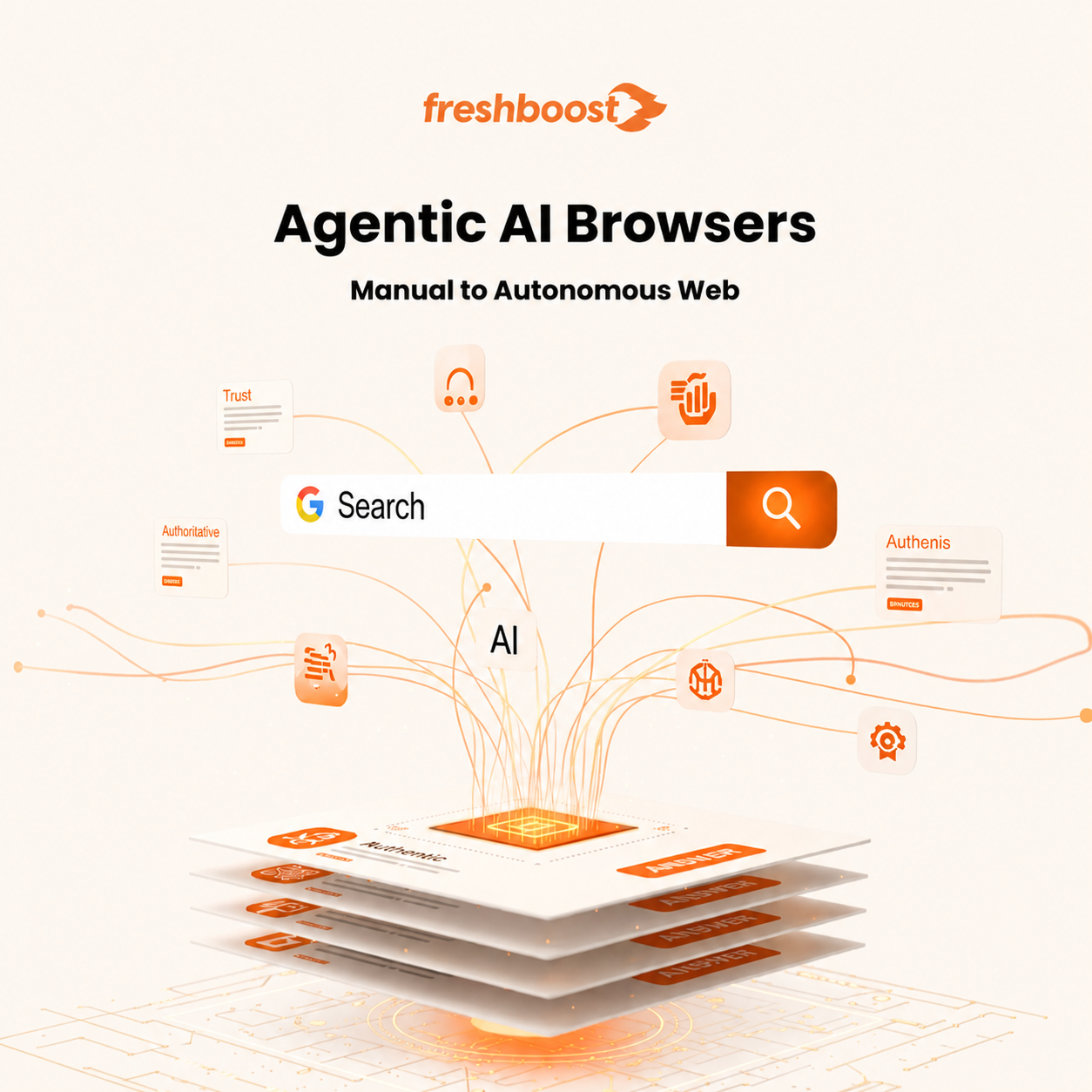
Agentic AI Browsers: The Shift From Manual to Autonomous Web
Early browsers were built for static exploration, where users manually navigated pages through links and basic search queries. As the web scaled, browsers evolved into intelligent gateways powered by recommendation systems that analyzed behavior, context, and data signals. These systems shaped what users saw, clicked, and consumed, quietly introducing automated decision making. This transition laid the foundation for browser use AI agent capabilities and marked the first step on a path toward autonomous intelligence, where browsing shifted from manual discovery to algorithm driven guidance.
How Agentic AI Browsers Actually Work
An agentic AI browser goes beyond assistance by understanding intent and acting independently. Instead of step by step commands, it plans and executes tasks using autonomous intelligence. This shifts browser use AI agent systems from passive tools to outcome driven execution, reducing manual interaction through intelligent delegation.
The rise of the auto agent AI browser became possible as large language models, tool orchestration, and memory systems matured. What started as simple AI powered features evolved into fully capable ai agentic browser architectures that operate across tabs, tools, and sessions. This evolution aligns with a broader path toward autonomous machine intelligence, where browsers no longer assist users but function as adaptive systems within the internet itself.
How Agentic AI Browsers Change User Decision Making
Intelligence Layer
The intelligence layer enables an agentic AI browser to interpret goals rather than follow explicit commands. Autonomous intelligence evaluates context, constraints, and intent to create planning, reasoning, and execution loops. These loops allow browser use AI agent systems to adapt actions dynamically as conditions change. By continuously learning from outcomes, this layer advances a path toward autonomous machine intelligence, where browsers manage complex objectives with minimal human intervention.
Interaction Layer
The interaction layer reshapes how users engage with the web by prioritizing natural language driven interfaces. Instead of manual navigation, users communicate intent conversationally, and the ai agentic browser translates it into actions. This reduces friction in human browser interaction and shifts control to high level guidance. As a result, users supervise outcomes while the system handles execution details reliably.
Economic Layer
The economic layer reflects how agentic AI browsers transform value creation online. Agent driven workflows automate digital labor such as research, coordination, and transactions. This automation accelerates decision cycles and introduces new internet incentives centered on efficiency and outcomes. As autonomous intelligence participates directly in workflows, the agentic AI browser becomes an active economic participant rather than a passive access tool.
Technology Enablers
Agentic AI browsers rely on large language models, tool orchestration, and persistent memory systems to function effectively. These components allow browser use AI agent architectures to reason across tools and sessions. Secure browser level execution environments provide boundaries for action, enabling autonomy while managing risk and reliability.
Why Agentic AI Browsers Are Needed in the Current AI World:
Modern browsing creates cognitive overload as users juggle tabs, tools, and AI systems simultaneously. Manual interaction breaks down in AI heavy environments where information volume exceeds human attention. Agentic AI browsers address this by shifting execution to autonomous intelligence. Browser use AI agent systems interpret intent, reduce decision friction, and coordinate actions across workflows. This allows users to focus on goals instead of managing steps, making complexity manageable at scale.
Agentic AI browsers revolutionize productivity by automating repetitive digital labor and compressing decision cycles. Auto agent AI browser architectures operate continuously, adapting to context without constant supervision. Over time, this changes how the internet functions, evolving from an information network into an execution layer. This transition marks a critical stage in the path toward autonomous machine intelligence, with long term implications for how users work, decide, and interact online.
Trust, Control, and Governance in the Agentic Web:
Trust
Trust becomes critical as agentic AI browsers begin making autonomous decisions on behalf of users. Autonomous intelligence must operate transparently, allowing users to understand why actions were taken and how outcomes were reached. Browser use AI agent systems build trust by aligning actions with user intent and maintaining consistent behavior across tasks. Without visibility into decision processes, delegation can quickly become a liability rather than an advantage.
Control
Control ensures that autonomy does not remove human authority. In an ai agentic browser, users define permission boundaries, scopes, and override mechanisms that guide agent behavior. Human oversight remains essential, especially when auto agent AI browser systems operate across sensitive workflows. Clear control layers allow users to intervene, pause, or redirect actions, preserving accountability.
Governance
Governance provides the structural safeguards that prevent misuse in the agentic web. It defines responsibility when AI driven browser actions fail, misuse data, or exceed intended limits. Governance frameworks establish auditing, compliance, and policy enforcement as autonomous intelligence scales. This foundation creates a natural transition into discussions around the glaring security risks with AI browser agents.
Examples of Agentic AI Browsers
Several browsers are beginning to adopt agentic patterns by embedding autonomous intelligence directly into browsing workflows. These systems emphasize browser use AI agent capabilities rather than surface level assistance.
Comet
Designed around AI agents that understand intent and execute tasks such as research, summarization, and action planning. It reflects early auto agent AI browser behavior focused on outcomes rather than navigation.
Adept ACT-1
Designed to operate browsers as an agent, ACT-1 performs actions across web interfaces. It demonstrates browser use AI agent behavior where execution replaces manual interaction.
Rabbit R1
Uses an agentic architecture to interact with web services on behalf of users. Though device based, it functions as an ai agentic browser by controlling browser workflows autonomously.
OpenAI Operator
Focuses on browser level task execution through autonomous decision making. Operator reflects a direct step toward agentic AI browser systems that act across websites without user micromanagement.
HyperWrite Agent
Uses AI agents to browse, decide, and complete tasks online. It emphasizes intent driven execution and represents applied autonomous intelligence in browser environments.

Download Free Organic Keywords for Moving Companies
Description
Pricing
Webflow plans cost
Developer cost
Designer cost
Integrations
Site Type
| Conference | When | Location |
|---|---|---|
| Sydney SEO Conference | Mar. 1, 2024 | Sydney, Australia |
| WTSFest London | Mar. 8, 2024 | London, UK |
| PubCon | Mar 4-6, 2024 | Las Vegas, US |
| SMX Munich | Mar. 12 & 13, 2024 | Munich, Germany |
| SMX Paris | Mar. 14 & 15, 2024 | Paris, France |
| Friends of Search | Mar. 21, 2024 | Amsterdam, Netherlands |
| SEO Mastery Summit | Apr. 9 - 11, 2024 | Ho Chi Minh City, Vietnam |
| BrightonSEO | Apr. 24 & 25, 2024 / Oct. 3 & 4, 2024 | Brighton, UK |
| Mozcon | Jun. 3 & 4, 2024 | Seattle, US |
| WTSFest Berlin | Jun. 7, 2024 | Berlin, Germany |
| LondonSEO XL | Jun. 13, 2024 | London, UK |
| SEO on the Beach | Jun. 14 & 15, 2024 | La Manga, Spain |
| WTSFest USA | Sep. 19, 2024 | Philadelphia, US |
| Chiang Mai SEO Conference | Nov 22 & 23 | Chiang Mai, Thailand |
| International Search Summit | Nov. 14, 2024 | Barcelona, Spain |
| BrightonSEO (US edition) | Nov. 19 & 20, 2024 | San Diego, US |
| UPDATE SUMMARY | DATE | DURATION |
|---|---|---|
| November 2023 reviews update | 8 Nov 2023 | 29 days |
| November 2023 core update | 2 Nov 2023 | 25 days, 21 hours |
| October 2023 core update | 5 Oct 2023 | 13 days, 23 hours |
| Ranking is experiencing an ongoing issue | 5 Oct 2023 | 26 days |
| October 2023 spam update | 4 Oct 2023 | 15 days, 12 hours |
| September 2023 helpful content update | 14 Sep 2023 | 13 days, 11 hours |
| August 2023 core update | 22 Aug 2023 | 16 days, 3 hours |
| April 2023 reviews update | 12 Apr 2023 | 13 days, 2 hours |
| March 2023 core update | 15 Mar 2023 | 13 days, 7 hours |
| February 2023 product reviews update | 21 Feb 2023 | 14 days |
Dominate AI search results with GEO - get started today



Frequently asked questions
Is SEO important for eCommerce platforms?

Yes, SEO is crucial for eCommerce platforms. It enhances visibility on search engines, attracts potential customers, and improves the chances of higher conversion rates, ultimately boosting online sales.
How to increase eCommerce sales with SEO?
To boost eCommerce sales with SEO, focus on keyword optimization, create high-quality and relevant content, optimize product pages, improve website speed, utilize social media, encourage customer reviews, and invest in a mobile-friendly design.
How Is SEO for E-commerce Different?
SEO for E-commerce differs in product-focused optimization, dealing with large inventories, optimizing product pages, handling duplicate content issues, addressing seasonal fluctuations, and focusing on user experience to encourage conversions. It's a specialized approach tailored for online retail.
Which Ecommerce Platform is Best for SEO?
There is no one-size-fits-all answer. Popular platforms like Shopify, WooCommerce, and Magento offer good SEO capabilities. The best choice depends on your business needs, content management preferences, and technical expertise.
What are the benefits of SEO for eCommerce Platform?
SEO for eCommerce platforms brings increased organic traffic, higher visibility in search engine results, improved user experience, enhanced credibility, and better chances of converting leads into customers, leading to increased sales and revenue.
Frequently asked questions
Is pay-per-click advertising worth it?
PPC advertising offers targeted reach, measurable results, and fast outcomes, making it valuable for businesses. It allows precise audience targeting and provides detailed analytics for performance tracking. While it delivers quick results, it requires ongoing investment and time for management. Additionally, competitiveness in certain industries can raise costs and pose challenges.
How is ranking different when comparing PPC vs SEO?
PPC: Paid placement based on bidding and ad quality for immediate results and precise targeting.SEO: Organic ranking influenced by website quality and content relevance, takes time to build and maintain.
How do SEO and PPC work together?
SEO and PPC complement each other by improving online visibility and driving traffic. PPC provides keyword insights for SEO, while SEO informs PPC strategies. PPC serves as a testing ground for SEO keywords, enhancing organic optimization efforts. Together, they increase SERP visibility, optimize landing pages, and improve user experience and conversions. Additionally, PPC data informs SEO content strategies, resulting in better online performance overall.
How much do PPC agencies charge?
PPC agencies offer services to assist businesses in handling their PPC campaigns, with costs typically ranging from $350 to $5,000 monthly or 12 to 30% of ad spend per month.
Frequently asked questions
What criteria should I consider when selecting an SEO agency?
When looking at how to choose an SEO agency, you’ll need to go through any available client testimonials that’ll be available in their website. Also, check if they’re transparent about their business approach to you and whether they possess a multi-disciplinary team.
How can I assess and evaluate the capabilities of an SEO agency?
When you research how to choose an SEO agency, you can evaluate their capabilities beforehand by going through their previous sample works, going through client testimonials and also going through community forums to check for reviews regarding the SEO Agency you’re looking out for.
What factors should I weigh when choosing an SEO specialist?
The factors that influence your question of how to choose an SEO agency should be to check if their portfolio is diverse, and whether they have good client testimonials, and they don’t guarantee you top ranks in Google’s search results.
What steps should I take to pick a local SEO company for my business?
Go through the company’s portfolio that is publicly available. Also, while looking for pointers on how to choose an SEO agency for your business, you can go through your local SEO agency’s client testimonials and research the company’s cultural dynamics.
Frequently asked questions
What is Plastic Surgery SEO?
Plastic surgery SEO is a specific type of search engine optimization (SEO) focused on attracting potential patients to a plastic surgeon's website. It involves various tactics to improve the website's visibility in search engine results for relevant keywords.
Why SEO for Plastic Surgeons Is Important?
SEO is an essential tool for plastic surgeons seeking to increase online visibility, rank high on SERP, attract qualified leads, and ultimately convert them into patients.
How long does it take for medical SEO to work?
Based on SEO strategies and the quality of content, initial improvements can be expected within the first three months. Achieving top positions in search results and driving traffic typically takes an average of six months.
How do you get plastic surgery leads?
Utilize 3D visualizations, Content Marketing & Webchat, patient-focused blogs, testimonials, mobile optimization, and SEO to generate plastic surgery leads.
Frequently asked questions
What is manufacturing SEO?
Manufacturing SEO involves optimizing a manufacturer's online presence to improve search engine rankings and visibility, attracting potential clients and enhancing brand awareness.
How does SEO benefit a manufacturing company?
SEO benefits manufacturing companies by increasing online visibility, attracting targeted leads, and establishing credibility, ultimately boosting brand awareness and facilitating business growth.
How can manufacturing companies improve SEO?
Manufacturing companies can enhance SEO by optimizing website content, incorporating relevant keywords, improving site speed, and utilizing quality backlinks for a stronger online presence.
How do you get plastic surgery leadsWhat is the main mistake of SEO that manufacturing companies make??
The main SEO mistake manufacturing companies make is neglecting to focus on industry-specific keywords and failing to regularly update and optimize their online content for search engines.
Frequently asked questions
Is Webflow better than WordPress for SEO?
Not universally. Webflow excels in speed and simplicity. WordPress excels in flexibility and scale.
Can Webflow rank as well as WordPress?
Yes. Rankings depend on strategy, not platform.
Which platform is better for beginners?
Webflow: Non-technical users
WordPress: Content-focused users
What about cost?
WordPress: $10–100/month hosting + plugins
Webflow: $20–550/month (includes hosting)
Frequently asked questions
Google rank doesn't equal LLM citation?
Correct. Ranking first means nothing if Claude or ChatGPT never cite you. Citation is the only GEO metric that matters.
Do I abandon Google SEO?
No. Maintain both their different games. Google wants rankings. LLMs want citations. Some tactics overlap; most don't.
Fastest way to boost citations?
Entity clarity. Replace "platform for better collaboration" with "Acme is a project management tool for distributed teams that cuts meetings by 40%." LLMs need to instantly understand what you are.
How do I know content is GEO-ready?
It's specific, original, backed by sources, and AI-readable. "Use structured data" gets skipped. "Use JSON-LD for product attributes" gets cited.
Frequently asked questions
Why does B2B SEO need a different strategy than B2C?
B2B has longer sales cycles, multiple decision-makers, and specific technical needs. You can't just chase high-volume keywords. Target intent instead.
How do I know what keywords to target?
Use intent-based research, not volume. Pick keywords where your ICP is actively evaluating solutions. Lower volume, but real buyers are searching.
My blog gets traffic, but no leads. What's wrong?
Awareness content alone doesn't convert. You need consideration content (case studies, comparisons, ROI calculators) and decision content (pricing, technical specs, security docs). Build the full funnel.
When will I see results?
Three to six months for meaningful results. Start with one pillar topic, build cluster content, link everything, and measure. Then scale what works.