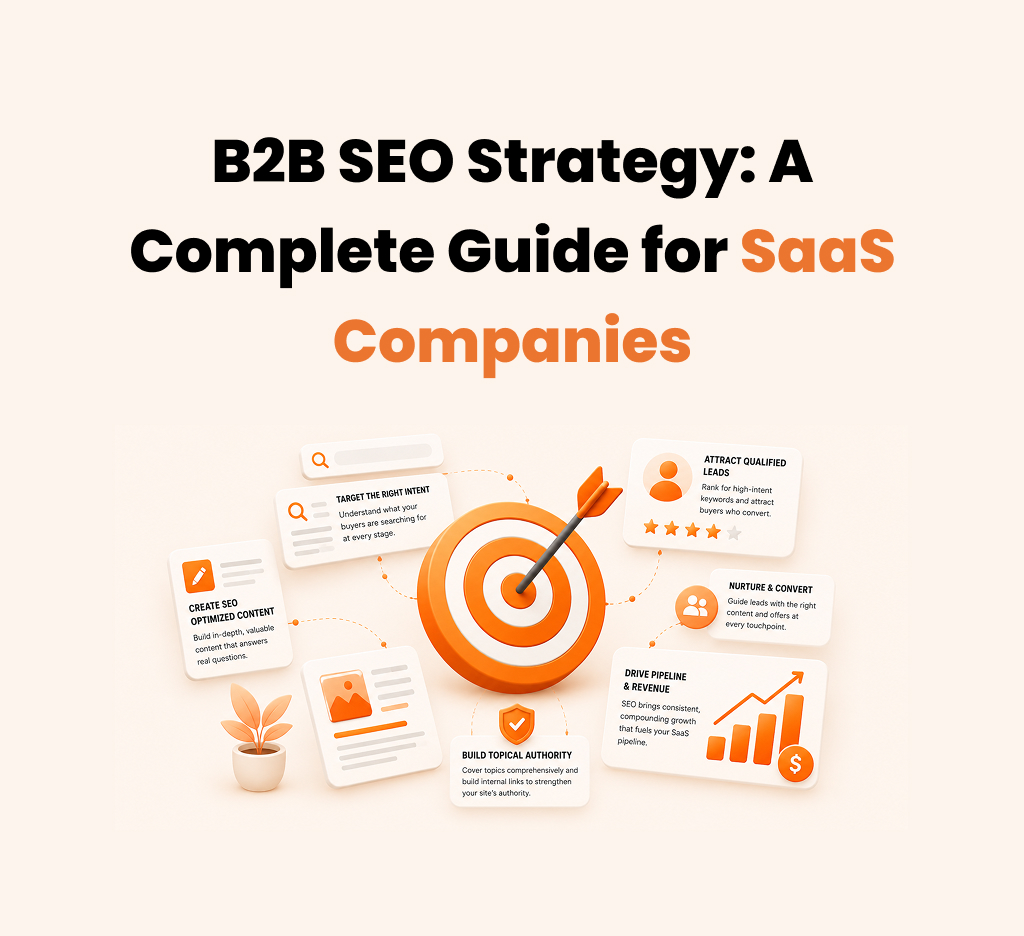
B2B SEO Strategy: A Complete Guide for SaaS Companies
You're publishing content. You're getting traffic. But your sales team still isn't getting leads.
That's because B2B SEO isn't about ranking for big search volumes. It's not about chasing keywords everyone searches. It's about understanding what your buyer actually needs, when they need it, and positioning your company to be there.
This guide shows you how. Not theory. The actual strategy SaaS companies use to go from invisible to the first search result for the keywords that matter.
What Is B2B SEO?
B2B SEO is search engine optimization designed specifically for business-to-business companies.
The core difference: B2B buyers have longer decision cycles, multiple stakeholders, and specific technical requirements. Your SEO strategy needs to account for all of that.
B2B SEO means:
- Targeting keywords that show buyer intent, not just search volume
- Creating content for every stage of the buyer journey
- Building topical authority so Google sees you as the expert
- Measuring what matters: qualified leads, not vanity metrics
Done right, it pulls qualified prospects to your website automatically. The sales team has real opportunities to work.
Why B2B SEO Is Different From B2C
B2C companies rank for high-volume, low-intent keywords. Someone searches "running shoes" and clicks on the first result.
B2B is different. A decision-maker searches "CRM implementation for enterprise" at 10 p.m. on a Wednesday. They're doing research. They might not be ready to buy. But they're serious. They have a problem. They're looking for solutions.
Here's what makes B2B harder:
Longer Sales Cycles. B2C: weeks. B2B: months or years. Your SEO can't just drive traffic. It needs to nurture people through a long journey.
Multiple Decision-Makers. Three people need to sign off. Your content needs to answer questions for the engineer, the manager, and the finance person.
Complex Buying Process. They need ROI docs. Security certifications. Integration guides. Product demos. Pricing transparency. B2C shoppers need product photos.
High Search Volume Competition. Enterprise software companies have massive budgets. They're bidding on the same keywords you are. Organic search is your advantage.
Keyword Difficulty. Keywords worth ranking for are competitive. You can't just publish a blog post and expect top rankings. You need a strategy.
B2B SEO requires understanding your buyer. Their pain. Their process. Their timeline. Then building content specifically for them.
The Problem Most SaaS Companies Face
Most SaaS companies have the same problem: too much awareness content, not enough consideration content.
They publish blog posts. Fifty of them. Tons of traffic from people just researching. But nobody converts.
Why? Because there's nowhere for them to go next.
Here's the typical breakdown:
Content Gap 1: Missing Consideration Assets. Blog posts exist. ROI calculators don't. Case studies don't. Comparison guides don't. So a reader finishes your blog and leaves. There's no reason to stay.
Content Gap 2: No Clear Messaging on Differentiation. You publish content about the problem. Every competitor does too. But what makes your solution different? That's not addressed.
Content Gap 3: Technical Content Doesn't Exist. Engineers search for integration guides, API documentation, and security specs. You have nothing. They go to your competitor's website instead.
Content Gap 4: Attribution Is Broken. You don't know which content is actually moving people forward. You can't measure SEO's impact on revenue. So you keep doing what you've always done, even if it doesn't work.
Content Gap 5: Keyword Strategy Is Wrong. You're ranking for keywords with no buyer intent. Or you're targeting keywords too competitive to ever win. Your keyword list wasn't built with buyer research in mind.
These gaps are why many SaaS companies have SEO traffic that doesn't convert. Not because SEO doesn't work. Because the strategy is broken.
The B2B SEO Framework That Works
A working B2B SEO strategy has five pillars. Each serves a specific purpose.
Pillar 1: Keyword Research Aligned to Buyer Intent
Most keyword research looks at search volume. You want keywords with high volume and low difficulty.
B2B keyword research is different. You want keywords that show intent.
"Best CRM software" has a huge volume. But people searching are comparing every option. Difficulty is insane.
"CRM for financial services with automated compliance reporting" has lower volume. But fewer competitors. And everyone searching for that phrase is a real prospect.
Your keyword research should answer three questions for each keyword:
- Does someone searching this phrase fit our ICP (Ideal Customer Profile)?
- Are they actively evaluating solutions?
- Can we reasonably rank for this?
Use tools like Ahrefs, Semrush, or even Google Search Console to understand what your customers actually search. Look at competitor websites. See what keywords they're ranking for. Identify the gaps they've missed.
Build your keyword list around buyer intent, not volume. You'll get fewer visitors. Better visitors.
Pillar 2: Buyer Journey Mapping
Every search query falls into one of three buyer stages.
Awareness Stage: The buyer realizes they have a problem. They search for general information. "How to reduce customer churn." "What is workflow automation?" They're researching the problem itself.
Consideration Stage: They know the problem. Now they're comparing solutions. "Best workflow automation tools." "CRM vs. project management software." They're researching options.
Decision Stage: They're ready to buy. They search for specific information that will help them choose. "Monday.com vs. Asana pricing." "HubSpot implementation timeline." "Salesforce security certification." They're evaluating specific options.
Your content needs to cover all three stages. But most B2B companies only have awareness content.
Build a content map. For each buyer persona, list the keywords they search at each stage. Then create content for each stage. Awareness content is easy. You probably have plenty. Build the middle. That's where the real conversion happens.
Pillar 3: Content Pillars and Cluster Strategy
Topic authority matters to Google. If you have 50 blog posts on random topics, you rank for nothing. If you have 10 in-depth pieces on core topics, with internal links connecting them, Google sees you as an expert.
A pillar strategy works like this:
Pick three to five core topics that matter to your ICP. For a CRM company, examples might be:
- "Sales team productivity"
- "Customer data management"
- "Sales pipeline optimization"
For each pillar, create one comprehensive guide (the pillar). Then create five to ten related articles (the cluster). Link them all together.
Example structure:
- Pillar: "Sales Pipeline Optimization: A Complete Guide"
- Cluster post: "How to structure your sales stages."
- Cluster post: "Sales pipeline metrics that matter."
- Cluster post: "How to forecast revenue accurately."
- Cluster post: "Why your sales pipeline is broken."
Google sees this as organized, authoritative content on a specific topic. You rank higher for every related keyword.
Pillar 4: Technical SEO Foundation
Your strategy doesn't matter if Google can't crawl your site.
Technical SEO basics:
- Fast load times (Google cares about Core Web Vitals)
- Mobile-responsive design (most B2B traffic is mobile)
- XML sitemap and robots.txt (helps Google crawl)
- HTTPS (security signal)
- Clean URL structure (shows topic hierarchy)
- Internal linking (passes authority between pages)
Most SaaS companies have these basics covered. But audit your site to be sure. Use Google Search Console to see what Google is seeing. Look for crawl errors. Fix broken links.
Pillar 5: Measurement That Matters
Most B2B companies measure the wrong things.
They track organic traffic. Bounce rate. Time on page. These are vanity metrics. They don't tell you if SEO is actually working.
Measure what matters:
- Qualified leads from organic. How many leads came from organic search? How many converted to customers?
- Cost per lead from SEO. Divide your SEO spend by qualified leads generated.
- Conversion rate by page. Which pages drive the most conversions? Double down on those.
- Time to conversion. How long does it take someone to go from the first organic visit to a qualified lead? Adjust your content strategy based on this.
- Revenue is influenced by organic. Using UTM parameters and CRM data, track how much revenue came from people who touched organic content at any point.
Set up proper tracking. Use Google Analytics 4 with goal tracking. Connect it to your CRM. Know which content moves people from prospect to customer.
This is how you prove SEO works. And how do you know what to optimize next?
B2B SEO Metrics SaaS Companies Should Track
Most SaaS companies focus on traffic growth as the primary SEO KPI. But traffic alone doesn't measure business impact. A successful B2B SEO strategy should track how organic search contributes to pipeline, revenue, and customer acquisition efficiency.
The most important B2B SEO metrics include:• Sales Qualified Leads (SQLs) from Organic Search
Track how many organic visitors become sales-qualified leads. This helps measure lead quality instead of just traffic volume.
• Pipeline Influenced by SEO
Measure how much revenue pipeline includes users who interacted with organic content during the buyer journey.
• Customer Acquisition Cost (CAC) from SEO
Compare your SEO investment against the number of customers acquired through organic channels to evaluate long-term efficiency.
• Demo and Trial Conversion Rates
Identify which landing pages, comparison pages, and solution-focused content generate product demos or free trial signups.
• Organic Revenue Attribution
Connect SEO performance with CRM and attribution tools to understand how organic search contributes to closed revenue.
• Non-Branded Organic Traffic Growth
Monitor growth from non-branded keywords to measure expansion in market visibility and topical authority.
• Assisted Conversions from Organic Content
Many B2B buyers visit multiple pages before converting. Assisted conversion tracking helps identify which content supports pipeline generation.
Tracking these metrics gives SaaS companies a clearer understanding of SEO performance beyond rankings and traffic. It also helps prioritize content investments that directly influence revenue growth.
B2B SEO Metrics SaaS Companies Should Track
Most SaaS companies focus on traffic growth as the primary SEO KPI. But traffic alone doesn't measure business impact. A successful B2B SEO strategy should track how organic search contributes to pipeline, revenue, and customer acquisition efficiency.The most important B2B SEO metrics include:• Sales Qualified Leads (SQLs) from Organic SearchTrack how many organic visitors become sales-qualified leads. This helps measure lead quality instead of just traffic volume.
• Pipeline Influenced by SEOMeasure how much revenue pipeline includes users who interacted with organic content during the buyer journey.
• Customer Acquisition Cost (CAC) from SEOCompare your SEO investment against the number of customers acquired through organic channels to evaluate long-term efficiency.
• Demo and Trial Conversion RatesIdentify which landing pages, comparison pages, and solution-focused content generate product demos or free trial signups.
• Organic Revenue AttributionConnect SEO performance with CRM and attribution tools to understand how organic search contributes to closed revenue.
• Non-Branded Organic Traffic GrowthMonitor growth from non-branded keywords to measure expansion in market visibility and topical authority.
• Assisted Conversions from Organic ContentMany B2B buyers visit multiple pages before converting. Assisted conversion tracking helps identify which content supports pipeline generation.
Tracking these metrics gives SaaS companies a clearer understanding of SEO performance beyond rankings and traffic. It also helps prioritize content investments that directly influence revenue growth.
How to Build Your B2B SEO Strategy: Step by Step
Step 1: Audit Your Current Situation (Week 1-2)
List your current traffic sources. How much comes from organic search? Break it down by page.
Look at your organic traffic by keyword. Which keywords are bringing people? Which are bringing qualified people?
Analyze your competitors. Which keywords are they ranking for? Which pages are they targeting? Where are the gaps you can exploit?
This audit shows you where you stand and where the opportunity is.
Step 2: Define Your ICP and Core Topics (Week 3-4)
Who is your ideal customer? Get specific. Not "companies in SaaS." More like: "Series A SaaS companies with product-market fit in B2B verticals, revenue between $2M-10M, looking to scale their sales process."
For this ICP, what are the three to five core problems they face? These become your pillar topics.
Example:
- Sales team scaling challenges
- Customer data management
- Revenue forecasting and pipeline visibility
Everything you create should tie back to these core topics.
Step 3: Build Your Keyword Map (Week 5-6)
For each core topic, research keywords at all three buyer stages. Use intent-based keyword research, not just volume.
Build a spreadsheet:
TopicAwareness KeywordsConsideration KeywordsDecision KeywordsSales Scaling"How to scale a sales team""Sales CRM comparison""HubSpot vs. Salesforce pricing"
This map guides everything you write next.
Step 4: Audit and Reorganize Existing Content (Week 7-8)
Map your existing content to this framework. You probably have awareness content. What's missing?
Audit your awareness content. Is it answering the right questions? Does it have CTAs pulling people forward?
Reorganize your website structure around your pillars. Create pillar pages. Organize cluster content underneath. Internal link everything together.
Step 5: Build Consideration Content (Week 9-14)
This is where most SaaS companies fail. You need:
- Case studies. Real customer results. Problem they faced, solution you provided, metrics. Numbers matter.
- Comparison guides. How does your approach compare to alternatives?
- ROI calculators. Help them quantify the benefit.
- Webinars. Educational content that builds trust.
- Customer testimonial pages. Real quotes from real customers.
Consideration content doesn't sell. It helps buyers understand why your solution is worth considering.
Step 6: Build Decision Content (Week 15-18)
Once you have considered content, create decision-stage assets:
- Detailed pricing pages. Be transparent. Buyers want to know.
- Technical documentation. How it integrates. Requirements. Specifications.
- Security and compliance docs. SOC 2. GDPR. HIPAA. Whatever matters to your buyer.
- Implementation timeline. How long does setup take? What does success look like?
- Customer references. Contact information for current customers willing to speak to prospects.
Step 7: Link Everything Together (Week 19-20)
Create a linking strategy. Your awareness content links to consideration content. Consideration content links to decision content.
Internal links serve two purposes: they help users navigate your site, and they pass authority to important pages.
Step 8: Optimize for Technical SEO (Week 21-22)
Test your site speed. Fix Core Web Vitals issues. Ensure mobile responsiveness. Clean up your URL structure. Set up proper redirect chains. Audit for duplicate content.
Step 9: Measure and Iterate (Ongoing)
Set up Google Analytics 4 with proper goal tracking. Connect it to your CRM. Start measuring qualified leads, conversions, and revenue influenced.
Every month, analyze what's working. Double down on high-performing content. Fix or remove underperforming content.
From SEO to Sales: Building the Complete System
SEO brings people to your website. But it's only the first step.
Once they arrive, your conversion system takes over. This is where a B2B content funnel becomes critical. The funnel takes your organic traffic and systematically moves people from prospect to sales-qualified lead.
SEO gets them to awareness content. The content funnel moves them through consideration and decision. Together, they create a system that converts traffic into customers.
Without the funnel, your SEO traffic doesn't convert. Without SEO, your funnel has nobody to work with. They need each other.
Common B2B SEO Mistakes
Mistake 1: Keyword Volume Over Intent
You target keywords with huge search volume. Everybody's looking for those. Impossible to rank. Pick lower-volume keywords with real buyer intent instead.
Mistake 2: Awareness Content Only
You publish blog posts. Nothing else. Readers never see consideration content. They leave. Build the full three-stage strategy.
Mistake 3: Poor Internal Linking
Your pages exist, but don't connect. Google can't understand your site structure. Authority isn't passed between pages. Plan your internal linking strategy upfront.
Mistake 4: Neglecting Technical Fundamentals
Your site is slow. Not mobile-friendly. Has crawl errors. You lose rankings and users before they even read your content.
Mistake 5: No Measurement System
You publish content but don't track what works. So you keep repeating what doesn't. Measure qualified leads, not just traffic.
Conclusion
B2B SEO is about building a strategy aligned to how your buyers actually search and decide.
Find the keywords showing real intent. Create content for every stage of their journey. Organize your site around core topics. Build consideration content-that's where you differ from competitors. Connect everything. Measure what matters.
This takes time. Three to six months before meaningful results. But once it works, you have an asset that generates leads on autopilot.
Start this week. Pick your core topic. Research the keywords. Build one pillar piece. Link your existing content to it. Measure what happens.
By next quarter, you'll have the foundation. By next year, you'll have a machine.
That's what B2B SEO does when it's done right.
FAQ
Q1: Why does B2B SEO need a different strategy than B2C?A: B2B has longer sales cycles, multiple decision-makers, and specific technical needs. You can't just chase high-volume keywords. Target intent instead.
Q2: My blog gets traffic, but no leads. What's wrong?A: Awareness content alone doesn't convert. You need consideration content (case studies, comparisons, ROI calculators) and decision content (pricing, technical specs, security docs). Build the full funnel.
Q3: How do I know what keywords to target?A: Use intent-based research, not volume. Pick keywords where your ICP is actively evaluating solutions. Lower volume, but real buyers are searching.
Q4: When will I see results?A: Three to six months for meaningful results. Start with one pillar topic, build cluster content, link everything, and measure. Then scale what works.

Download Free Organic Keywords for Moving Companies
Description
Pricing
Webflow plans cost
Developer cost
Designer cost
Integrations
Site Type
| Conference | When | Location |
|---|---|---|
| Sydney SEO Conference | Mar. 1, 2024 | Sydney, Australia |
| WTSFest London | Mar. 8, 2024 | London, UK |
| PubCon | Mar 4-6, 2024 | Las Vegas, US |
| SMX Munich | Mar. 12 & 13, 2024 | Munich, Germany |
| SMX Paris | Mar. 14 & 15, 2024 | Paris, France |
| Friends of Search | Mar. 21, 2024 | Amsterdam, Netherlands |
| SEO Mastery Summit | Apr. 9 - 11, 2024 | Ho Chi Minh City, Vietnam |
| BrightonSEO | Apr. 24 & 25, 2024 / Oct. 3 & 4, 2024 | Brighton, UK |
| Mozcon | Jun. 3 & 4, 2024 | Seattle, US |
| WTSFest Berlin | Jun. 7, 2024 | Berlin, Germany |
| LondonSEO XL | Jun. 13, 2024 | London, UK |
| SEO on the Beach | Jun. 14 & 15, 2024 | La Manga, Spain |
| WTSFest USA | Sep. 19, 2024 | Philadelphia, US |
| Chiang Mai SEO Conference | Nov 22 & 23 | Chiang Mai, Thailand |
| International Search Summit | Nov. 14, 2024 | Barcelona, Spain |
| BrightonSEO (US edition) | Nov. 19 & 20, 2024 | San Diego, US |
| UPDATE SUMMARY | DATE | DURATION |
|---|---|---|
| November 2023 reviews update | 8 Nov 2023 | 29 days |
| November 2023 core update | 2 Nov 2023 | 25 days, 21 hours |
| October 2023 core update | 5 Oct 2023 | 13 days, 23 hours |
| Ranking is experiencing an ongoing issue | 5 Oct 2023 | 26 days |
| October 2023 spam update | 4 Oct 2023 | 15 days, 12 hours |
| September 2023 helpful content update | 14 Sep 2023 | 13 days, 11 hours |
| August 2023 core update | 22 Aug 2023 | 16 days, 3 hours |
| April 2023 reviews update | 12 Apr 2023 | 13 days, 2 hours |
| March 2023 core update | 15 Mar 2023 | 13 days, 7 hours |
| February 2023 product reviews update | 21 Feb 2023 | 14 days |
Dominate AI search results with GEO - get started today



Frequently asked questions
Is SEO important for eCommerce platforms?

Yes, SEO is crucial for eCommerce platforms. It enhances visibility on search engines, attracts potential customers, and improves the chances of higher conversion rates, ultimately boosting online sales.
How to increase eCommerce sales with SEO?
To boost eCommerce sales with SEO, focus on keyword optimization, create high-quality and relevant content, optimize product pages, improve website speed, utilize social media, encourage customer reviews, and invest in a mobile-friendly design.
How Is SEO for E-commerce Different?
SEO for E-commerce differs in product-focused optimization, dealing with large inventories, optimizing product pages, handling duplicate content issues, addressing seasonal fluctuations, and focusing on user experience to encourage conversions. It's a specialized approach tailored for online retail.
Which Ecommerce Platform is Best for SEO?
There is no one-size-fits-all answer. Popular platforms like Shopify, WooCommerce, and Magento offer good SEO capabilities. The best choice depends on your business needs, content management preferences, and technical expertise.
What are the benefits of SEO for eCommerce Platform?
SEO for eCommerce platforms brings increased organic traffic, higher visibility in search engine results, improved user experience, enhanced credibility, and better chances of converting leads into customers, leading to increased sales and revenue.
Frequently asked questions
Is pay-per-click advertising worth it?
PPC advertising offers targeted reach, measurable results, and fast outcomes, making it valuable for businesses. It allows precise audience targeting and provides detailed analytics for performance tracking. While it delivers quick results, it requires ongoing investment and time for management. Additionally, competitiveness in certain industries can raise costs and pose challenges.
How is ranking different when comparing PPC vs SEO?
PPC: Paid placement based on bidding and ad quality for immediate results and precise targeting.SEO: Organic ranking influenced by website quality and content relevance, takes time to build and maintain.
How do SEO and PPC work together?
SEO and PPC complement each other by improving online visibility and driving traffic. PPC provides keyword insights for SEO, while SEO informs PPC strategies. PPC serves as a testing ground for SEO keywords, enhancing organic optimization efforts. Together, they increase SERP visibility, optimize landing pages, and improve user experience and conversions. Additionally, PPC data informs SEO content strategies, resulting in better online performance overall.
How much do PPC agencies charge?
PPC agencies offer services to assist businesses in handling their PPC campaigns, with costs typically ranging from $350 to $5,000 monthly or 12 to 30% of ad spend per month.
Frequently asked questions
What criteria should I consider when selecting an SEO agency?
When looking at how to choose an SEO agency, you’ll need to go through any available client testimonials that’ll be available in their website. Also, check if they’re transparent about their business approach to you and whether they possess a multi-disciplinary team.
How can I assess and evaluate the capabilities of an SEO agency?
When you research how to choose an SEO agency, you can evaluate their capabilities beforehand by going through their previous sample works, going through client testimonials and also going through community forums to check for reviews regarding the SEO Agency you’re looking out for.
What factors should I weigh when choosing an SEO specialist?
The factors that influence your question of how to choose an SEO agency should be to check if their portfolio is diverse, and whether they have good client testimonials, and they don’t guarantee you top ranks in Google’s search results.
What steps should I take to pick a local SEO company for my business?
Go through the company’s portfolio that is publicly available. Also, while looking for pointers on how to choose an SEO agency for your business, you can go through your local SEO agency’s client testimonials and research the company’s cultural dynamics.
Frequently asked questions
What is Plastic Surgery SEO?
Plastic surgery SEO is a specific type of search engine optimization (SEO) focused on attracting potential patients to a plastic surgeon's website. It involves various tactics to improve the website's visibility in search engine results for relevant keywords.
Why SEO for Plastic Surgeons Is Important?
SEO is an essential tool for plastic surgeons seeking to increase online visibility, rank high on SERP, attract qualified leads, and ultimately convert them into patients.
How long does it take for medical SEO to work?
Based on SEO strategies and the quality of content, initial improvements can be expected within the first three months. Achieving top positions in search results and driving traffic typically takes an average of six months.
How do you get plastic surgery leads?
Utilize 3D visualizations, Content Marketing & Webchat, patient-focused blogs, testimonials, mobile optimization, and SEO to generate plastic surgery leads.
Frequently asked questions
What is manufacturing SEO?
Manufacturing SEO involves optimizing a manufacturer's online presence to improve search engine rankings and visibility, attracting potential clients and enhancing brand awareness.
How does SEO benefit a manufacturing company?
SEO benefits manufacturing companies by increasing online visibility, attracting targeted leads, and establishing credibility, ultimately boosting brand awareness and facilitating business growth.
How can manufacturing companies improve SEO?
Manufacturing companies can enhance SEO by optimizing website content, incorporating relevant keywords, improving site speed, and utilizing quality backlinks for a stronger online presence.
How do you get plastic surgery leadsWhat is the main mistake of SEO that manufacturing companies make??
The main SEO mistake manufacturing companies make is neglecting to focus on industry-specific keywords and failing to regularly update and optimize their online content for search engines.
Frequently asked questions
Is Webflow better than WordPress for SEO?
Not universally. Webflow excels in speed and simplicity. WordPress excels in flexibility and scale.
Can Webflow rank as well as WordPress?
Yes. Rankings depend on strategy, not platform.
Which platform is better for beginners?
Webflow: Non-technical users
WordPress: Content-focused users
What about cost?
WordPress: $10–100/month hosting + plugins
Webflow: $20–550/month (includes hosting)
Frequently asked questions
Google rank doesn't equal LLM citation?
Correct. Ranking first means nothing if Claude or ChatGPT never cite you. Citation is the only GEO metric that matters.
Do I abandon Google SEO?
No. Maintain both their different games. Google wants rankings. LLMs want citations. Some tactics overlap; most don't.
Fastest way to boost citations?
Entity clarity. Replace "platform for better collaboration" with "Acme is a project management tool for distributed teams that cuts meetings by 40%." LLMs need to instantly understand what you are.
How do I know content is GEO-ready?
It's specific, original, backed by sources, and AI-readable. "Use structured data" gets skipped. "Use JSON-LD for product attributes" gets cited.
Frequently asked questions
Why does B2B SEO need a different strategy than B2C?
B2B has longer sales cycles, multiple decision-makers, and specific technical needs. You can't just chase high-volume keywords. Target intent instead.
How do I know what keywords to target?
Use intent-based research, not volume. Pick keywords where your ICP is actively evaluating solutions. Lower volume, but real buyers are searching.
My blog gets traffic, but no leads. What's wrong?
Awareness content alone doesn't convert. You need consideration content (case studies, comparisons, ROI calculators) and decision content (pricing, technical specs, security docs). Build the full funnel.
When will I see results?
Three to six months for meaningful results. Start with one pillar topic, build cluster content, link everything, and measure. Then scale what works.