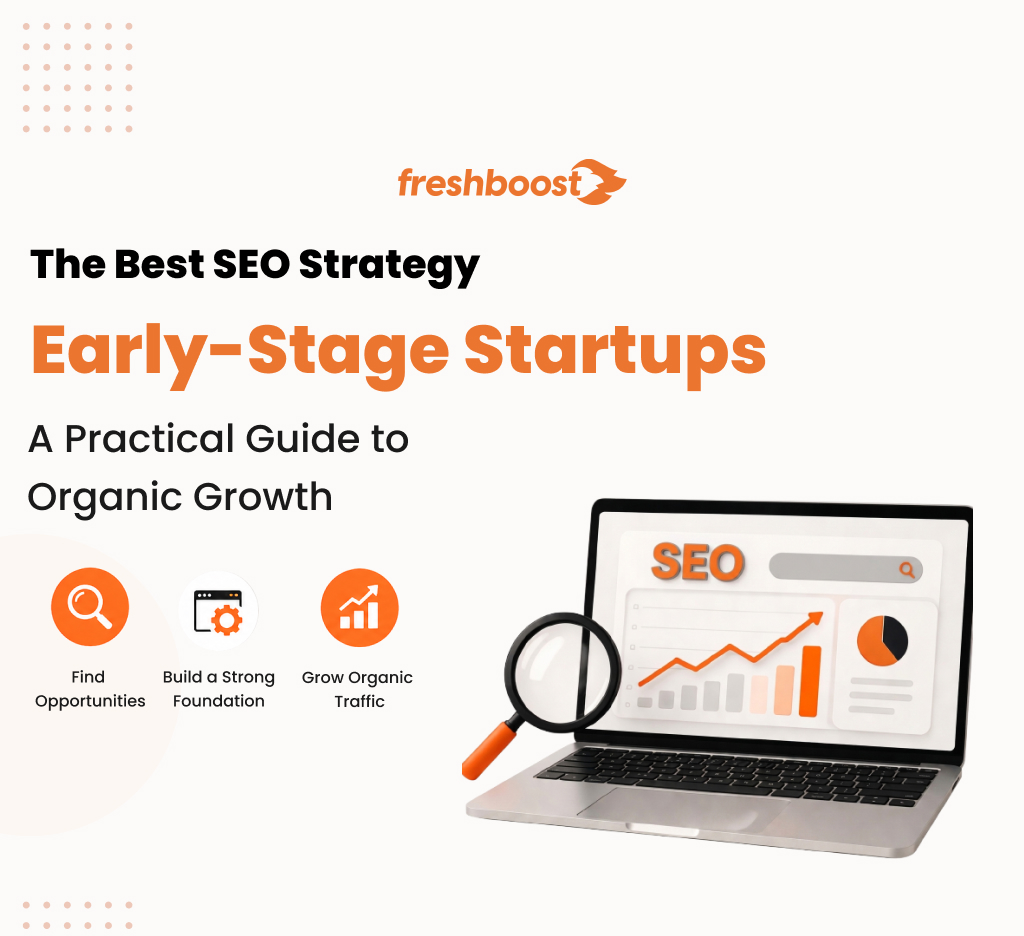
The Best SEO Strategy for Early-Stage Startups: A Practical Guide to Organic Growth
Your startup solves a real problem. Yet your target customers can't find you.Paid advertising generates results, but the cost per acquisition continues to climb higher each month.Your budget is finite, and you need a sustainable channel for customer acquisition that actually works.
SEO addresses this challenge. Not as a tactical fix, but as a strategic foundation for compounding growth.For early-stage startups, SEO represents the difference between unsustainable customer acquisition costs and building real assets.It's the engine that generates qualified traffic year after year without burning through your budget.
This guide provides a practical framework for implementing SEO at your startup effectively.Each step is designed for immediate execution, without unnecessary complexity or confusing jargon.You'll understand exactly what to do, when to do it, and why it matters for your business.
An effective SEO strategy for startups focuses on targeting low-competition keywords, building high-quality content, optimizing technical SEO, and earning backlinks to drive long-term organic growth.
Why Startups Need SEO (And Why It Beats Paid Ads)
Early-stage startups operate under significant constraints that shape every decision you make.You have limited capital, competitive markets, and urgent growth requirements driving everything forward.In this environment, finding sustainable acquisition channels becomes the difference between surviving and thriving.
Paid advertising delivers immediate results but creates dependency on continuous spending.When you stop spending, traffic ceases and leads dry up within days.SEO builds ownership and real estate that belongs to you in search results.
When a prospect searches for your solution, your website appears earned and authoritative.You're not paying per click; you've established visibility through real expertise and authority.This fundamental difference changes everything about your economics and business sustainability.
Core Pillars of SEO Strategy for Startups
SEO effectiveness depends on three interconnected elements working together seamlessly.Each pillar strengthens the others, and all three must be present for real rankings.Understanding these three layers helps you allocate your limited resources effectively.
Technical SEO addresses the infrastructure layer that search engines depend on completely.Site speed, mobile responsiveness, crawlability, and indexation directly impact your ability to rank.A slow or poorly structured website undermines even the best content and strategy.
Content Strategy drives visibility and engagement with real customers searching for solutions.Articles, guides, and resources that answer customer questions establish your expertise clearly.Content is where strategy translates into measurable results and actual traffic.
Authority and Backlinks build trust signals that search engines recognize and reward.Inbound links from relevant, authoritative websites indicate credibility to Google and other engines.Authority accumulation requires time but delivers the competitive advantage you need.
For resource-constrained startups, the implementation priority is clear and strategic.Establish technical foundations first, then prioritize content creation for your audience.Authority building follows naturally as your content gains real traction.
Step-by-Step SEO Strategy for Early-Stage Startups
Step 1: Keyword Research (Find What Your Customers Are Searching)
Keyword research establishes your content foundation and strategic direction going forward.Identify which search queries your prospects use when looking for solutions.Prioritize keywords where ranking is actually achievable for your new domain.
Target keywords with "Low" to "Medium" difficulty scores where you can win.Specificity favors startups significantly—"SEO for SaaS companies" ranks more readily than "SEO."Long-tail keywords convert higher intent customers and face significantly less competition.
Essential keyword research tools you should use:
- Google Keyword Planner (free but limited in scope)
- Semrush (comprehensive and detailed data)
- Ahrefs (excellent for competitive analysis)
- Moz Keyword Explorer (user-friendly interface)
Document your top 20-30 target keywords to guide content strategy forward.These keywords become your roadmap for the next six months of content creation.Focus on depth with fewer keywords rather than shallow coverage of many.
Step 2: Website Foundation (Technical SEO Basics)
Technical SEO ensures search engines can crawl, index, and understand your site properly.Before publishing content, address these fundamentals that form your foundation.Skipping this step leads to months of wasted content effort later.
Site speed directly impacts rankings and user experience across all devices.Use Google PageSpeed Insights to identify performance issues holding you back.Slow sites harm rankings and cause visitors to leave before engaging.
Mobile optimization is non-negotiable in today's search landscape and user behavior.Over 60% of searches occur on mobile devices in most industries.Test your site on phones and verify mobile usability in Google Search Console.
Site structure helps both users and search engines navigate your information.Organize content logically with a clear hierarchy that makes sense.This foundational architecture prevents wasted effort and improves rankings significantly.
Setup essentials require minimal time but prevent massive problems later.Configure Google Search Console and Google Analytics to measure performance accurately.These tools identify improvement opportunities and track your progress continuously.
Step 3: Content Strategy (What to Write About and Why)
Content drives organic visibility and traffic to your website consistently.Effective strategy maps directly to customer buying stages and search intent.This alignment ensures your content reaches prospects at the right moment.
Identify problems customers face at awareness, consideration, and decision stages specifically.Create content addressing each stage of their journey through your sales funnel.This buyer journey framework ensures content reaches prospects regardless of where they are.
Implementation approach requires consistent effort and strategic thinking.Develop a content calendar targeting one to two substantial posts weekly.Focus on long-form content (1,500+ words) that thoroughly answers customer questions.
Prioritize how-to guides, problem-solution articles, and comparison content over trends.Monitor customer support interactions and community discussions for content topics.Consistency matters more than perfection in building organic traffic.
Step 4: On-Page Optimization (Making Search Engines Understand Your Content)
On-page optimization clarifies relevance to search engines and improves engagement.These elements work together to improve rankings and user experience simultaneously.Each optimization decision compounds with others to boost your visibility.
Title and meta description are your first impression in search results.Incorporate your target keyword naturally into the title tag under 60 characters.Write a compelling 160-character meta description that encourages clicks from search results.
Content structure helps both users and search engines understand what you're saying.Use headers (H2, H3) to break content into sections logically.This improves readability and search engine comprehension of your main topics.
Internal linking and image optimization complete the on-page foundation.Link to relevant pages within your site to establish information hierarchy.Use descriptive filenames and alt text for accessibility and image search visibility.
Step 5: Building Authority (Getting Backlinks)
Backlinks signal credibility to search engines and real authority in your space.For startups, authority builds through earned links, not purchased schemes.This authentic approach builds sustainable competitive advantage over time.
Create link-worthy content that naturally attracts inbound links from relevant sites.Original research, comprehensive guides, and unique insights attract links naturally.When you publish something truly valuable, people want to reference it.
Strategic outreach identifies opportunities where your content deserves links.Identify relevant websites covering your industry or adjacent spaces.If your content surpasses existing resources, propose linking opportunities respectfully.
Relationship building generates link opportunities through authentic engagement.Engage authentically in industry communities and with content creators genuinely.Guest contribution on industry publications includes relevant links to your site.
Authority compounds over time as your content gains recognition and value.Early-stage startups should focus on creating exceptional content first.Selectively pursue high-quality linking opportunities that make sense for your business.
Common SEO Mistakes Startups Make (And How to Avoid Them)
1. Targeting competitive keywords prematurely limits your success significantly.New websites lack the authority to rank for high-difficulty keywords.Focus on long-tail, lower-difficulty keywords where ranking is actually achievable.
2. Neglecting technical foundations undermines all your content efforts completely.Content alone doesn't ensure rankings without speed, mobile, and crawlability.Site speed, mobile responsiveness, and crawlability directly impact your performance.
3. Inconsistent publishing schedules prevent compounding growth from happening.Sporadic content publishes don't compound effectively or build momentum.Sustainable publishing schedules—one to two articles weekly—build real topical authority.
4. Optimizing for search engines instead of users damages your credibility.Keyword-stuffed, poorly written content harms user experience and trust.Write for your audience first; search engines reward user satisfaction.
5. Expecting immediate results leads to abandoning strategy too early.SEO typically requires three to six months before generating measurable traffic.Startups that abandon strategy after two months miss the inflection point.
6. Skipping analytics and measurement means flying blind without feedback.Without tracking rankings, traffic, and conversion data, you can't improve.Implement measurement infrastructure before publishing your first post.
Quick Action Plan
Week 1:
Set up Google Search Console and Google Analytics right away.Run your website through Google PageSpeed Insights and fix critical issues.Verify mobile responsiveness across devices and research 20-30 target keywords.
Month 1:
Build a three-month content calendar targeting priority keywords strategically.Optimize homepage and key pages for your target keywords.Publish your first long-form blog post (1,500+ words) on your best keyword.
Months 2-3:
Maintain consistent publication schedule of one to two posts weekly.Monitor rankings and traffic in Google Search Console continuously.Identify top-performing content and create related pieces addressing related queries.
Conclusion
SEO builds sustainable competitive advantage that compounds in value continuously.Content published today delivers qualified leads across multiple quarters.The startups winning now began six months ago, so start this week.

Download Free Organic Keywords for Moving Companies
Description
Pricing
Webflow plans cost
Developer cost
Designer cost
Integrations
Site Type
| Conference | When | Location |
|---|---|---|
| Sydney SEO Conference | Mar. 1, 2024 | Sydney, Australia |
| WTSFest London | Mar. 8, 2024 | London, UK |
| PubCon | Mar 4-6, 2024 | Las Vegas, US |
| SMX Munich | Mar. 12 & 13, 2024 | Munich, Germany |
| SMX Paris | Mar. 14 & 15, 2024 | Paris, France |
| Friends of Search | Mar. 21, 2024 | Amsterdam, Netherlands |
| SEO Mastery Summit | Apr. 9 - 11, 2024 | Ho Chi Minh City, Vietnam |
| BrightonSEO | Apr. 24 & 25, 2024 / Oct. 3 & 4, 2024 | Brighton, UK |
| Mozcon | Jun. 3 & 4, 2024 | Seattle, US |
| WTSFest Berlin | Jun. 7, 2024 | Berlin, Germany |
| LondonSEO XL | Jun. 13, 2024 | London, UK |
| SEO on the Beach | Jun. 14 & 15, 2024 | La Manga, Spain |
| WTSFest USA | Sep. 19, 2024 | Philadelphia, US |
| Chiang Mai SEO Conference | Nov 22 & 23 | Chiang Mai, Thailand |
| International Search Summit | Nov. 14, 2024 | Barcelona, Spain |
| BrightonSEO (US edition) | Nov. 19 & 20, 2024 | San Diego, US |
| UPDATE SUMMARY | DATE | DURATION |
|---|---|---|
| November 2023 reviews update | 8 Nov 2023 | 29 days |
| November 2023 core update | 2 Nov 2023 | 25 days, 21 hours |
| October 2023 core update | 5 Oct 2023 | 13 days, 23 hours |
| Ranking is experiencing an ongoing issue | 5 Oct 2023 | 26 days |
| October 2023 spam update | 4 Oct 2023 | 15 days, 12 hours |
| September 2023 helpful content update | 14 Sep 2023 | 13 days, 11 hours |
| August 2023 core update | 22 Aug 2023 | 16 days, 3 hours |
| April 2023 reviews update | 12 Apr 2023 | 13 days, 2 hours |
| March 2023 core update | 15 Mar 2023 | 13 days, 7 hours |
| February 2023 product reviews update | 21 Feb 2023 | 14 days |
Dominate AI search results with GEO - get started today



Frequently asked questions
Is SEO important for eCommerce platforms?

Yes, SEO is crucial for eCommerce platforms. It enhances visibility on search engines, attracts potential customers, and improves the chances of higher conversion rates, ultimately boosting online sales.
How to increase eCommerce sales with SEO?
To boost eCommerce sales with SEO, focus on keyword optimization, create high-quality and relevant content, optimize product pages, improve website speed, utilize social media, encourage customer reviews, and invest in a mobile-friendly design.
How Is SEO for E-commerce Different?
SEO for E-commerce differs in product-focused optimization, dealing with large inventories, optimizing product pages, handling duplicate content issues, addressing seasonal fluctuations, and focusing on user experience to encourage conversions. It's a specialized approach tailored for online retail.
Which Ecommerce Platform is Best for SEO?
There is no one-size-fits-all answer. Popular platforms like Shopify, WooCommerce, and Magento offer good SEO capabilities. The best choice depends on your business needs, content management preferences, and technical expertise.
What are the benefits of SEO for eCommerce Platform?
SEO for eCommerce platforms brings increased organic traffic, higher visibility in search engine results, improved user experience, enhanced credibility, and better chances of converting leads into customers, leading to increased sales and revenue.
Frequently asked questions
Is pay-per-click advertising worth it?
PPC advertising offers targeted reach, measurable results, and fast outcomes, making it valuable for businesses. It allows precise audience targeting and provides detailed analytics for performance tracking. While it delivers quick results, it requires ongoing investment and time for management. Additionally, competitiveness in certain industries can raise costs and pose challenges.
How is ranking different when comparing PPC vs SEO?
PPC: Paid placement based on bidding and ad quality for immediate results and precise targeting.SEO: Organic ranking influenced by website quality and content relevance, takes time to build and maintain.
How do SEO and PPC work together?
SEO and PPC complement each other by improving online visibility and driving traffic. PPC provides keyword insights for SEO, while SEO informs PPC strategies. PPC serves as a testing ground for SEO keywords, enhancing organic optimization efforts. Together, they increase SERP visibility, optimize landing pages, and improve user experience and conversions. Additionally, PPC data informs SEO content strategies, resulting in better online performance overall.
How much do PPC agencies charge?
PPC agencies offer services to assist businesses in handling their PPC campaigns, with costs typically ranging from $350 to $5,000 monthly or 12 to 30% of ad spend per month.
Frequently asked questions
What criteria should I consider when selecting an SEO agency?
When looking at how to choose an SEO agency, you’ll need to go through any available client testimonials that’ll be available in their website. Also, check if they’re transparent about their business approach to you and whether they possess a multi-disciplinary team.
How can I assess and evaluate the capabilities of an SEO agency?
When you research how to choose an SEO agency, you can evaluate their capabilities beforehand by going through their previous sample works, going through client testimonials and also going through community forums to check for reviews regarding the SEO Agency you’re looking out for.
What factors should I weigh when choosing an SEO specialist?
The factors that influence your question of how to choose an SEO agency should be to check if their portfolio is diverse, and whether they have good client testimonials, and they don’t guarantee you top ranks in Google’s search results.
What steps should I take to pick a local SEO company for my business?
Go through the company’s portfolio that is publicly available. Also, while looking for pointers on how to choose an SEO agency for your business, you can go through your local SEO agency’s client testimonials and research the company’s cultural dynamics.
Frequently asked questions
What is Plastic Surgery SEO?
Plastic surgery SEO is a specific type of search engine optimization (SEO) focused on attracting potential patients to a plastic surgeon's website. It involves various tactics to improve the website's visibility in search engine results for relevant keywords.
Why SEO for Plastic Surgeons Is Important?
SEO is an essential tool for plastic surgeons seeking to increase online visibility, rank high on SERP, attract qualified leads, and ultimately convert them into patients.
How long does it take for medical SEO to work?
Based on SEO strategies and the quality of content, initial improvements can be expected within the first three months. Achieving top positions in search results and driving traffic typically takes an average of six months.
How do you get plastic surgery leads?
Utilize 3D visualizations, Content Marketing & Webchat, patient-focused blogs, testimonials, mobile optimization, and SEO to generate plastic surgery leads.
Frequently asked questions
What is manufacturing SEO?
Manufacturing SEO involves optimizing a manufacturer's online presence to improve search engine rankings and visibility, attracting potential clients and enhancing brand awareness.
How does SEO benefit a manufacturing company?
SEO benefits manufacturing companies by increasing online visibility, attracting targeted leads, and establishing credibility, ultimately boosting brand awareness and facilitating business growth.
How can manufacturing companies improve SEO?
Manufacturing companies can enhance SEO by optimizing website content, incorporating relevant keywords, improving site speed, and utilizing quality backlinks for a stronger online presence.
How do you get plastic surgery leadsWhat is the main mistake of SEO that manufacturing companies make??
The main SEO mistake manufacturing companies make is neglecting to focus on industry-specific keywords and failing to regularly update and optimize their online content for search engines.
Frequently asked questions
Is Webflow better than WordPress for SEO?
Not universally. Webflow excels in speed and simplicity. WordPress excels in flexibility and scale.
Can Webflow rank as well as WordPress?
Yes. Rankings depend on strategy, not platform.
Which platform is better for beginners?
Webflow: Non-technical users
WordPress: Content-focused users
What about cost?
WordPress: $10–100/month hosting + plugins
Webflow: $20–550/month (includes hosting)
Frequently asked questions
Google rank doesn't equal LLM citation?
Correct. Ranking first means nothing if Claude or ChatGPT never cite you. Citation is the only GEO metric that matters.
Do I abandon Google SEO?
No. Maintain both their different games. Google wants rankings. LLMs want citations. Some tactics overlap; most don't.
Fastest way to boost citations?
Entity clarity. Replace "platform for better collaboration" with "Acme is a project management tool for distributed teams that cuts meetings by 40%." LLMs need to instantly understand what you are.
How do I know content is GEO-ready?
It's specific, original, backed by sources, and AI-readable. "Use structured data" gets skipped. "Use JSON-LD for product attributes" gets cited.
Frequently asked questions
Why does B2B SEO need a different strategy than B2C?
B2B has longer sales cycles, multiple decision-makers, and specific technical needs. You can't just chase high-volume keywords. Target intent instead.
How do I know what keywords to target?
Use intent-based research, not volume. Pick keywords where your ICP is actively evaluating solutions. Lower volume, but real buyers are searching.
My blog gets traffic, but no leads. What's wrong?
Awareness content alone doesn't convert. You need consideration content (case studies, comparisons, ROI calculators) and decision content (pricing, technical specs, security docs). Build the full funnel.
When will I see results?
Three to six months for meaningful results. Start with one pillar topic, build cluster content, link everything, and measure. Then scale what works.