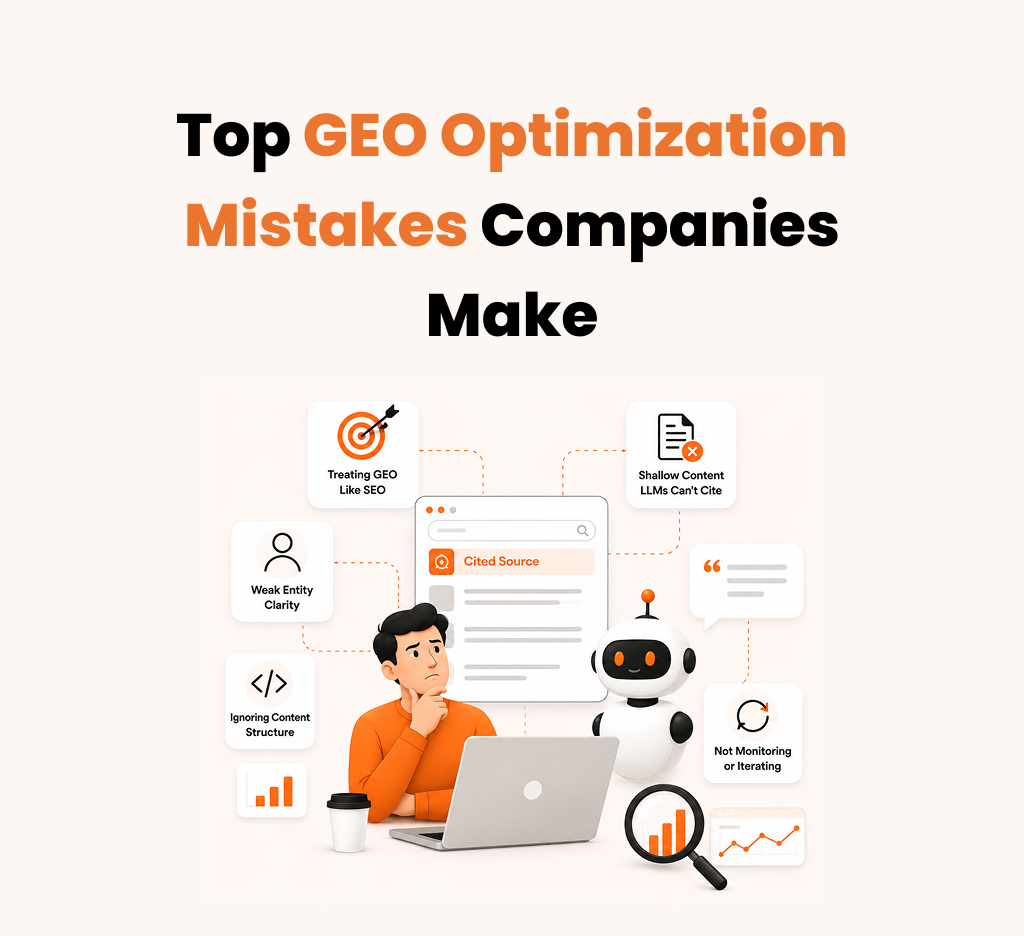
Top GEO Optimization Mistakes Companies Make
The shift to AI-powered search was supposed to be straightforward. Optimize for LLMs. Get cited. Win visibility. But most companies are getting it wrong, and they don't realize until the damage is done.
We've worked with dozens of brands trying to crack Generative Engine Optimization, and the pattern is always the same: they apply old SEO thinking to a fundamentally different game. They chase metrics that don't matter anymore. They optimize for the wrong audience. They ship content that LLMs can't confidently cite. And by the time they figure it out, their competitors have already locked in the narrative.
Here are the five mistakes killing your GEO strategy right now.
Mistake #1: Treating GEO Like SEO
This is the biggest one. Traditional SEO is about ranking. GEO is about being cited. These are not the same thing.
A page that ranks first on Google but never appears in Claude or ChatGPT responses? Worthless. A page that ranks tenth but gets cited by every major LLM? That's gold. But teams keep measuring what they've always measured: keyword positions, click-through rates, organic traffic. Wrong lens entirely.
LLMs don't rank pages. They retrieve sources and cite them to answer specific queries. The metrics that matter are:
- Citation frequency across AI platforms
- Answer type distribution (direct answer vs. reference vs. comparison)
- Competitor comparison in AI-generated results
Most tools will tell you this, but you have to actually believe it. Your CEO probably still cares about Google rankings. That's fine. Maintain them. But that's not where GEO wins are won.
Start by asking: In the last month, how many times did an LLM cite my content? If you don't know, you're flying blind. Use tools that actually track this instead of guessing based on traditional SEO metrics.
Mistake #2: Weak Entity Clarity
LLMs think in entities, not keywords. If your content doesn't make it dead obvious what you are, what you do, and how you fit into a category, you lose.
Here's the mistake: writing like a human. That works for Google. It doesn't work for AI.
A human reads: "Our platform helps teams collaborate better." An LLM reads that and stays confused because it's abstract. What platform? What kind of collaboration? What's the outcome?
An LLM reads: "Acme Task Manager is a project management tool for distributed engineering teams. It reduces meeting overhead by 40% through asynchronous task updates and inline collaboration." Suddenly, it understands who you are, what problem you solve, and why it should cite you.
The fix is unglamorous: define your entities explicitly. Your product. Your category. Your differentiator. Your outcomes. Do this in your H1. Do it in your opening paragraph. Do it in your headers. Repeat it. Be redundant. LLMs reward clarity more than elegance.
Most companies bury this in marketing fluff. Don't. Make your identity impossible to miss.
Mistake #3: Shallow Content That LLMs Can't Confidently Cite
LLMs cite sources when they feel confident that a source is accurate, authoritative, and specific. Most corporate content fails on all three counts.
Inaccuracy: Claims without backing. Stats without source dates. Generalizations without nuance. LLMs detect this through training data inconsistencies. If your content contradicts what they learned from 100 other sources, they skip you.
Lack of authority: Surface-level explanations. No original research. No frameworks that feel like they came from real thinking. LLMs cite sources that demonstrate expertise, not sources that repeat what everyone else says.
Lack of specificity: Vague recommendations. Generic advice. No examples, no data, no context. LLMs need concrete details to extract and cite confidently. "Use structured data" is too vague. "Use JSON-LD schema for your product pages to explicitly define attributes, pricing, and availability" is citable.
The fix: go deep on fewer topics. Pick ten things you're genuinely an expert on and produce comprehensive, original content on those topics. Include research, examples, frameworks, and specifics. That's better than producing fifty shallow pieces.
Mistake #4: Ignoring Content Structure for AI Readability
Your beautiful prose doesn't matter if LLMs can't parse it.
This means:
- Clear heading hierarchies so AI models understand topic relationships
- Scannable sections with purpose-driven paragraphs
- Consistent terminology across related concepts
- Explicit context before introducing nuance
You also need proper schema markup. Not just basic structured data. An advanced schema that defines entities, relationships, and attributes. This is the translator between your prose and what LLMs extract.
Most companies use schema mark-up at maybe 20% effectiveness. They add basic ProductSchema or ArticleSchema and call it done. LLMs need more: specific entity relationships, attribute clarity, context tags that help models understand what each section is for.
This gets technical, but the right approach starts with auditing your current structure and identifying gaps. Then you systematically improve markup and reorganize content for clarity.
A side benefit: this also helps traditional SEO. But for GEO, it's non-negotiable.
Mistake #5: Not Monitoring or Iterating
You optimize once and move on. Wrong.
GEO requires continuous testing. AI platforms change constantly. Citation patterns shift. New competitors emerge with better content. What worked in January might not work in May.
The mistake is a lack of systematic monitoring:
- No monthly audits of how LLMs are citing you
- No competitive analysis of what content appears in AI answers
- No tracking of citation trends over time
- No A/B testing of different content approaches
The fix is straightforward but boring: check your GEO metrics monthly. Same rhythm as SEO reviews. Pick your top ten pages that should be cited and track citation frequency. Run competitive audits. Identify your biggest gaps. Optimize the top three gaps. Wait 30 days. Repeat.
Most teams skip this because it's not glamorous. It's just data review and incremental improvement. But that's exactly why it works. Your competitors are probably not doing it.
The Bigger Picture: Strategy First, Mistakes Second
All five of these mistakes trace back to one root cause: companies haven't internalized that GEO is a different game.
Traditional SEO strategy assumes: optimize content → improve rankings → get clicks → convert traffic.
GEO strategy assumes: create authoritative sources → make them AI-readable → become a cited reference → earn passive visibility.
The path is different. The metrics are different. The optimization tactics are different. But most companies are still trying to play SEO while the game has shifted to GEO.
If you're serious about fixing this, start with strategy. Understand what GEO actually requires, not as a feature add-on, but as a core business strategy. Then cascade down to tactics: entity clarity, content depth, structural optimization, schema markup, and ongoing monitoring.
Skip the strategy step, and you'll keep making these mistakes.
Where to Start?
Pick one mistake. Usually it's Mistake #1: actually believing GEO is different from SEO.
Run an audit. Find your top pages. Check how often LLMs cite them. If the answer is "rarely" or "never," you have work to do. Compare that to competitors. See if they're citing better content, more specific content, or just better structured content.
Then fix the one thing that will have the most impact. Usually, it's entity clarity (Mistake #2) or content depth (Mistake #3). Do that. Wait 30 days. Measure again.
That's the path. Not fast. Not easy. But it works because it's what actually moves the needle for GEO.
Are the companies winning right now? They stopped thinking like SEOs. They started thinking like LLMs. They ask: "How would Claude cite this? What would ChatGPT need to confidently reference this? When Perplexity answers this question, why would it choose us over competitors?"
That mindset shift is harder than any tactic. But everything else flows from it.

Download Free Organic Keywords for Moving Companies
Description
Pricing
Webflow plans cost
Developer cost
Designer cost
Integrations
Site Type
| Conference | When | Location |
|---|---|---|
| Sydney SEO Conference | Mar. 1, 2024 | Sydney, Australia |
| WTSFest London | Mar. 8, 2024 | London, UK |
| PubCon | Mar 4-6, 2024 | Las Vegas, US |
| SMX Munich | Mar. 12 & 13, 2024 | Munich, Germany |
| SMX Paris | Mar. 14 & 15, 2024 | Paris, France |
| Friends of Search | Mar. 21, 2024 | Amsterdam, Netherlands |
| SEO Mastery Summit | Apr. 9 - 11, 2024 | Ho Chi Minh City, Vietnam |
| BrightonSEO | Apr. 24 & 25, 2024 / Oct. 3 & 4, 2024 | Brighton, UK |
| Mozcon | Jun. 3 & 4, 2024 | Seattle, US |
| WTSFest Berlin | Jun. 7, 2024 | Berlin, Germany |
| LondonSEO XL | Jun. 13, 2024 | London, UK |
| SEO on the Beach | Jun. 14 & 15, 2024 | La Manga, Spain |
| WTSFest USA | Sep. 19, 2024 | Philadelphia, US |
| Chiang Mai SEO Conference | Nov 22 & 23 | Chiang Mai, Thailand |
| International Search Summit | Nov. 14, 2024 | Barcelona, Spain |
| BrightonSEO (US edition) | Nov. 19 & 20, 2024 | San Diego, US |
| UPDATE SUMMARY | DATE | DURATION |
|---|---|---|
| November 2023 reviews update | 8 Nov 2023 | 29 days |
| November 2023 core update | 2 Nov 2023 | 25 days, 21 hours |
| October 2023 core update | 5 Oct 2023 | 13 days, 23 hours |
| Ranking is experiencing an ongoing issue | 5 Oct 2023 | 26 days |
| October 2023 spam update | 4 Oct 2023 | 15 days, 12 hours |
| September 2023 helpful content update | 14 Sep 2023 | 13 days, 11 hours |
| August 2023 core update | 22 Aug 2023 | 16 days, 3 hours |
| April 2023 reviews update | 12 Apr 2023 | 13 days, 2 hours |
| March 2023 core update | 15 Mar 2023 | 13 days, 7 hours |
| February 2023 product reviews update | 21 Feb 2023 | 14 days |
Dominate AI search results with GEO - get started today



Frequently asked questions
Is SEO important for eCommerce platforms?

Yes, SEO is crucial for eCommerce platforms. It enhances visibility on search engines, attracts potential customers, and improves the chances of higher conversion rates, ultimately boosting online sales.
How to increase eCommerce sales with SEO?
To boost eCommerce sales with SEO, focus on keyword optimization, create high-quality and relevant content, optimize product pages, improve website speed, utilize social media, encourage customer reviews, and invest in a mobile-friendly design.
How Is SEO for E-commerce Different?
SEO for E-commerce differs in product-focused optimization, dealing with large inventories, optimizing product pages, handling duplicate content issues, addressing seasonal fluctuations, and focusing on user experience to encourage conversions. It's a specialized approach tailored for online retail.
Which Ecommerce Platform is Best for SEO?
There is no one-size-fits-all answer. Popular platforms like Shopify, WooCommerce, and Magento offer good SEO capabilities. The best choice depends on your business needs, content management preferences, and technical expertise.
What are the benefits of SEO for eCommerce Platform?
SEO for eCommerce platforms brings increased organic traffic, higher visibility in search engine results, improved user experience, enhanced credibility, and better chances of converting leads into customers, leading to increased sales and revenue.
Frequently asked questions
Is pay-per-click advertising worth it?
PPC advertising offers targeted reach, measurable results, and fast outcomes, making it valuable for businesses. It allows precise audience targeting and provides detailed analytics for performance tracking. While it delivers quick results, it requires ongoing investment and time for management. Additionally, competitiveness in certain industries can raise costs and pose challenges.
How is ranking different when comparing PPC vs SEO?
PPC: Paid placement based on bidding and ad quality for immediate results and precise targeting.SEO: Organic ranking influenced by website quality and content relevance, takes time to build and maintain.
How do SEO and PPC work together?
SEO and PPC complement each other by improving online visibility and driving traffic. PPC provides keyword insights for SEO, while SEO informs PPC strategies. PPC serves as a testing ground for SEO keywords, enhancing organic optimization efforts. Together, they increase SERP visibility, optimize landing pages, and improve user experience and conversions. Additionally, PPC data informs SEO content strategies, resulting in better online performance overall.
How much do PPC agencies charge?
PPC agencies offer services to assist businesses in handling their PPC campaigns, with costs typically ranging from $350 to $5,000 monthly or 12 to 30% of ad spend per month.
Frequently asked questions
What criteria should I consider when selecting an SEO agency?
When looking at how to choose an SEO agency, you’ll need to go through any available client testimonials that’ll be available in their website. Also, check if they’re transparent about their business approach to you and whether they possess a multi-disciplinary team.
How can I assess and evaluate the capabilities of an SEO agency?
When you research how to choose an SEO agency, you can evaluate their capabilities beforehand by going through their previous sample works, going through client testimonials and also going through community forums to check for reviews regarding the SEO Agency you’re looking out for.
What factors should I weigh when choosing an SEO specialist?
The factors that influence your question of how to choose an SEO agency should be to check if their portfolio is diverse, and whether they have good client testimonials, and they don’t guarantee you top ranks in Google’s search results.
What steps should I take to pick a local SEO company for my business?
Go through the company’s portfolio that is publicly available. Also, while looking for pointers on how to choose an SEO agency for your business, you can go through your local SEO agency’s client testimonials and research the company’s cultural dynamics.
Frequently asked questions
What is Plastic Surgery SEO?
Plastic surgery SEO is a specific type of search engine optimization (SEO) focused on attracting potential patients to a plastic surgeon's website. It involves various tactics to improve the website's visibility in search engine results for relevant keywords.
Why SEO for Plastic Surgeons Is Important?
SEO is an essential tool for plastic surgeons seeking to increase online visibility, rank high on SERP, attract qualified leads, and ultimately convert them into patients.
How long does it take for medical SEO to work?
Based on SEO strategies and the quality of content, initial improvements can be expected within the first three months. Achieving top positions in search results and driving traffic typically takes an average of six months.
How do you get plastic surgery leads?
Utilize 3D visualizations, Content Marketing & Webchat, patient-focused blogs, testimonials, mobile optimization, and SEO to generate plastic surgery leads.
Frequently asked questions
What is manufacturing SEO?
Manufacturing SEO involves optimizing a manufacturer's online presence to improve search engine rankings and visibility, attracting potential clients and enhancing brand awareness.
How does SEO benefit a manufacturing company?
SEO benefits manufacturing companies by increasing online visibility, attracting targeted leads, and establishing credibility, ultimately boosting brand awareness and facilitating business growth.
How can manufacturing companies improve SEO?
Manufacturing companies can enhance SEO by optimizing website content, incorporating relevant keywords, improving site speed, and utilizing quality backlinks for a stronger online presence.
How do you get plastic surgery leadsWhat is the main mistake of SEO that manufacturing companies make??
The main SEO mistake manufacturing companies make is neglecting to focus on industry-specific keywords and failing to regularly update and optimize their online content for search engines.
Frequently asked questions
Is Webflow better than WordPress for SEO?
Not universally. Webflow excels in speed and simplicity. WordPress excels in flexibility and scale.
Can Webflow rank as well as WordPress?
Yes. Rankings depend on strategy, not platform.
Which platform is better for beginners?
Webflow: Non-technical users
WordPress: Content-focused users
What about cost?
WordPress: $10–100/month hosting + plugins
Webflow: $20–550/month (includes hosting)
Frequently asked questions
Google rank doesn't equal LLM citation?
Correct. Ranking first means nothing if Claude or ChatGPT never cite you. Citation is the only GEO metric that matters.
Do I abandon Google SEO?
No. Maintain both their different games. Google wants rankings. LLMs want citations. Some tactics overlap; most don't.
Fastest way to boost citations?
Entity clarity. Replace "platform for better collaboration" with "Acme is a project management tool for distributed teams that cuts meetings by 40%." LLMs need to instantly understand what you are.
How do I know content is GEO-ready?
It's specific, original, backed by sources, and AI-readable. "Use structured data" gets skipped. "Use JSON-LD for product attributes" gets cited.
Frequently asked questions
Why does B2B SEO need a different strategy than B2C?
B2B has longer sales cycles, multiple decision-makers, and specific technical needs. You can't just chase high-volume keywords. Target intent instead.
How do I know what keywords to target?
Use intent-based research, not volume. Pick keywords where your ICP is actively evaluating solutions. Lower volume, but real buyers are searching.
My blog gets traffic, but no leads. What's wrong?
Awareness content alone doesn't convert. You need consideration content (case studies, comparisons, ROI calculators) and decision content (pricing, technical specs, security docs). Build the full funnel.
When will I see results?
Three to six months for meaningful results. Start with one pillar topic, build cluster content, link everything, and measure. Then scale what works.